- Joined
- Aug 2, 2009
- Messages
- 2,019
A Century of War - Part 1 (1848-1875) can be found here.
"Hey YSD, I can't help but notice you didn't even mention Asia at all in your first entry. What's up with that? It was 'World War' II, not 'European War' II." Or maybe you didn't notice, because nobody mentioned it. lol
As a growing nation bound by the limits of their island(s), Japan began to see the need to expand. Advisors to Japan (interestingly and perhaps coincidentally enough, these were suggestions primarily from Prussian advisors) suggested that Korea was an ideal spot for expansion. It was of close proximity to the Japanese mainland which worked two ways--Chinese forces had been gathering there so it was also suggested that, if left alone, Korea would become a threat to Japan's own existence. Therefore, Japan forced Korea to be a major trading partner with them and gradually began to expand into Korea. This ended up splitting Korea into Chinese- and Japanese-allied (or, at the very least, "-favoring") sides.
 Fighting between Russia and the Ottoman Empire had gone on at a near-constant basis for the previous 200 years by this point, and there just kept being more fuel added to the fire. Russia felt that they had lost too much territory to the Ottoman Empire in the wake of the Crimean War (yet alone not gained those lands which they had originally went to war to conquer). To acquire these lands, and to continue the PanSlavic Movement (hence the involvement with the Balkan tribes), Russia went to war with the Ottoman Empire yet again.
I know what you are thinking, because I thought it too at first..."Err...they just tried this twenty years ago...and every single 10-20 (it varied) years before that..." But this time it was different...Interestingly enough, in each of the previous wars between these two nations, if it was a one-on-one battle, Russia was victorious. It was when the Ottoman Empire had help from allies (or simply enough another nation decided to intervene, not necessarily from a pro-Ottoman view) that Russia was unsuccessful. The only two nations who could have stopped the Russians and who would have even tried, were the French and the British. France currently had to deal with the threat of Germany and Britain was struggling with both the Industrial Revolution (a very focus-drawing factor) and struggles with the Irish people. Both were too preoccupied to deal with pretty much anything else at the moment.
The Russian+Balkan forces (or perhaps I should just say the "Slavic forces") had great success and drove the Ottomans back rather easily. They were perhaps too successful, as the British saw the danger in remaining uninvolved in the conflict and pressured to Russians to accept the Ottoman-offered truce, essentially setting things back to the pre-war status quo.
The three nations were in an alliance, but shortly before the Russo-Turkish War, Russia left the alliance. They PanSlavic Movement had started and Russia showed favoritism to the Slavic people who were in Austria's territories. In fact, more than that, ideally those people and regions would become Russian, but Austria wasn't too thrilled about the prospect of giving them up, so Russia left the alliance. This caused Austria and Germany to form the "Dual Alliance" which said they would come to the others aid in the event of war. Interestingly enough, this was chiefly (though not solely) in reference to Russia.
However...ever the diplomat, Otto von Bismarck knew that Russia was going to feel cheated by the results of the truce with the Ottoman Empire. Therefore, he offered alliance to Russia for the second time and the League of the Three Emperors was reformed. Then, two years later in 1881, they disbanded for the second time. This time it was under complete neutrality--Russia just plain decided they wanted out, not on the potentially-hostile terms as before (this is not entirely true...nations don't form or disband alliance just on a whim, but for our purposes--for this "study"--it will suffice).
 Instead of the previously-used first come, first served snatch-n-grab used in Africa and Asia for new territories, there was an attempt to "section off" the entire African continent. After all, why cause more tension and potential war (as the struggles for Africa had been inevitably leading towards)? Of course...things such as this are never truly "fair" or "equal", and nobody appeared to give consideration (or maybe just didn't care) that maybe Africa should belong to the Africans.
 After recovering from their own unification and various struggles, Italy was looking to become one of the European powers and became involved (as more of a minor player) in the Scramble for Africa. They had hoped to take Tunisia, being closest to them, but France seized it instead. Knowing that Germany and Austria-Hungary were in alliance (and mainly against the threats of France and Russia), Italy formed an alliance with the two of them. If any member of the Triple Alliance was attacked by any other two nations (or just France alone), the other two nations in the alliance would come to their aid.
Let me make sure you got that. "If any member of the Triple Alliance was attacked by any other two nations (or just France alone), the other two nations in the alliance would come to their aid." We will reference this again on Thursday.
 This, if you recall, actually started (tension and conflict between the two, that is), ten years prior to the all-out war. At this point, however, Austria joined the Serbian side, having worked out a deal where they expected Serbia to take over Bulgarian lands and, in return (for their assistance), to give up regions of the Western Balkans to Austria (ironically very similar to what the Italians and French did to the Austrians just years earlier). Really though, Austria-Hungary had the entire Balkan region on their wish list for themselves. The Russians, still seeking the PanSlavic Movement, were on both sides of the war, essentially (and thereby really on no side). Russia would have liked to become involved, but where? Bulgaria was still an Ottoman Empire puppet state, so they couldn't take their side. Serbia was being encroached on and stalked by Austria, so they couldn't take their side either.
In the end the Bulgarians won (with a surprisingly low casualties on both sides, in terms of percentage of combatants and ferocity of the fighting). Though the Austrians attempted to "help" a Slavic people, Russia knew their intent so it caused more issues between Russian-Austrian relations.
You see, in modern times we see the United States as a sort of world's peacekeepers, or perhaps just as somebody who sticks their nose in everybody else's business. Britain was doing this long before we started though, assuming the role of the people who kept everybody else from complete anarchy.
In 1888, the German Emperor Wilhelm I died. His son took over as Emperor, but due to his throat cancer, he only held that position for three months before dying. That made Wilhelm I's grandson, Wilhelm II, the new Emperor at just 29 years old. Both Wilhelm I and Bismarck were patient, gradual men, who understood how to keep pride in check. The young Wilhelm II, however, was impatient and impulsive. He couldn't stand Bismarck's careful, systematic approach to foreign relations and thought Germany should just take what they wanted and make their mark in history. In response, Bismarck had no respect for Wilhelm II and even used his clout to attempt to enact laws without Wilhelm's permission. In response, Wilhelm II relieved Bismarck of his duties.
This famous cartoon, titled "Dropping the Pilot", portrays the symbolism of what that did--the driving force behind German success and preservation was now gone.

Later that year, Russia approached Germany, requesting a renewal of the Reinsurance Treaty. They had signed it under Bismarck/Wilhelm I's leadership and hoped for it to remain under Wilhelm II's. This was a monumental statement to the abilities of Bismarck--that he could get such a large and powerful and proud power, who had twice removed themselves from alliances with Germany, to be the ones to approach Germany themselves, hoping that their relationship with Bismarck would be the same with Wilhelm II.
Wilhelm II's officials already leaned more towards the old Triple Alliance with just Austria+Italy and Wilhelm believed he had a strong enough personal relationship with Tsar Alexander III of Russia that the treaty wouldn't be necessary, so he declined.
 Over the previous 20 years, France and Russia developed better and better relations with one another. After all, they hadn't had any issues since France's involvement in the Crimean War, which was itself had understandable circumstances for both sides' involvement. Both sides more or less had different areas of concern until 1890. When Germany refused to renew the Reinsurance Treaty, Russia got nervous. Why shouldn't they? Germany more obviously portrayed themselves as being part of the Triple Alliance, so there were three powers who didn't want Russia included. This alone would make a nation nervous, but added to this, the fact that there had been recent hostilities against Russia and/or alliances against Russia by members of the Triple Alliance just enhanced that feeling. On the other hand, having improved relations with another nation with whom they had a perceived common enemy, Russia and France just kept getting closer and closer until they forged an alliance in 1892. Actually, it was drafted in 1892, but not finalized until 1894. The terms of this alliance stated that it would remain in existence so long as the Triple Alliance remained.
In 1894, pro-Japanese Koreans sought to overthrow the Korean emperor and government (remember--this was a Chinese puppet government). The Emperor requested assistance from China, who obliged. Considering this to be a direct violation of their agreement, Japan also sent a force into Korea. When there, they managed to seize and occupy the Royal Palace and placed pro-Japanese Koreans in charge. Just as the Chinese claimed that their response to Korea was legal (since it was requested by Korea), the new government requested the presence of Japanese forces. This, by the same reasoning, made the Japanese presence legal, and more Japanese forces were thereby sent to Korea. China viewed this new government as illegitimate and the Japanese actions as menacing and hostile, so the tables of battle were set.
Since Japan was on an upward trend and China on a downward one, Japan ended up winning the war, having much success in Korea, Taiwan and Manchuria. Japan relinquished Manchuria, but kept most of their other gains from the war. Japan was forced out of the Liaodong Peninsula by the Russians, which caused much tension between Russia and Japan (they just kind of snuck in and claimed it in the middle of everything and there wasn't much anything Japan could do about it). Even more worrisome to Japan, was that Russia might seek to do the same thing with Korea, and then maybe not stopping at Korea, but continuing on to Japan itself. The remains of broken China began to get gobbled up by European nations such as Britain, Germany and France, as so much of Asia already had.
 The two main participants in the Scramble for Africa were Britain and France. Their fierce competition for parts of Africa almost lead to military confrontation between the two of them, but (partially thanks to stalemate in maneuvering of forces in Africa by both sides) eventually came up with a compromise. Both sides were actually rather happy with the agreement (a rare win-win situation) and it lead to very favorable views of each other in the near future.
He hoped if he intentionally failed, that his father would relax and let him follow his dream of becoming an artist, but instead his father responded by pushing him even harder. Though he was Austrian, and lived in Austria, and his family had served the Austrian government (swearing allegiance to the Austrian monarchy), he rebelled against his father by developing a deep obsession to German nationalism and loyalty.
The more his father pushed, the more "German" Adolf Hitler became.
"Hey YSD, I can't help but notice you didn't even mention Asia at all in your first entry. What's up with that? It was 'World War' II, not 'European War' II." Or maybe you didn't notice, because nobody mentioned it. lol
Prelude to the First Sino-Japanese War (1876)
China, Japan, Korea
The Asian side of things really got started in 1876. For centuries beforehand, Japan had remained in near-complete isolation, but just recently had struck an industrial revolution, thereby making them a major powerhouse in the East. China, on the other hand, had enjoyed centuries of being an unstoppable force, but lost much of their power in the events of the 1800s, especially the "Opium Wars" against Britain. China, Japan, Korea
More about Marco Polo

More than just a game to be played in a pool, Marco Polo was one of the great explorers of the world. Amongst many other things, he was one of the first "Gaijin" (foreigners) to visit the island nation in the heart of the age of the Samurai. Actually, technically it was several close constituents and business partners of Polo while he was visiting China, but...technicalities lol. It would still be another 600 years before the Japanese were forced from isolation, however.
As a growing nation bound by the limits of their island(s), Japan began to see the need to expand. Advisors to Japan (interestingly and perhaps coincidentally enough, these were suggestions primarily from Prussian advisors) suggested that Korea was an ideal spot for expansion. It was of close proximity to the Japanese mainland which worked two ways--Chinese forces had been gathering there so it was also suggested that, if left alone, Korea would become a threat to Japan's own existence. Therefore, Japan forced Korea to be a major trading partner with them and gradually began to expand into Korea. This ended up splitting Korea into Chinese- and Japanese-allied (or, at the very least, "-favoring") sides.
Russo-Turkish War (1877-78)
Russia + Balkan tribes v. Ottoman Empire
Russia + Balkan tribes v. Ottoman Empire
What is the PanSlavic Movement? Good question. Whether it was an excuse for expansion, or a genuine desire to see a reunification of the "Slavic" people (or perhaps likely both), this was the term used for the push to reunite all "Slavic" people, spread across Europe. They consist of many different "groups" of people, but all originally came from the region of (roughly) Ukraine. Even now, their different languages are all categorized as "Slavic."
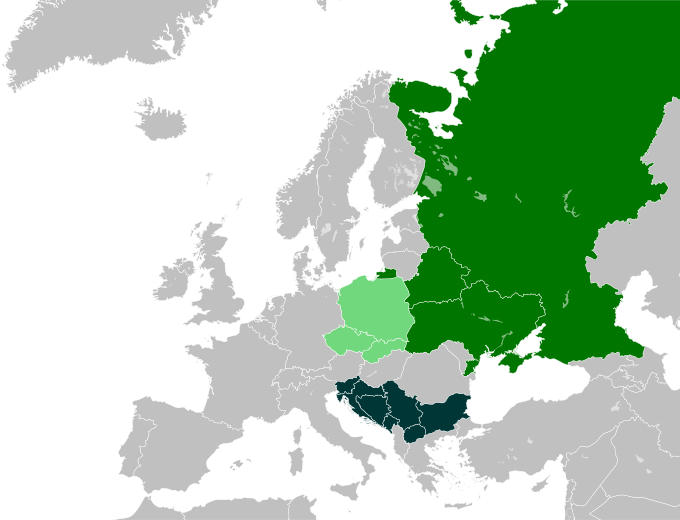
I know what you are thinking, because I thought it too at first..."Err...they just tried this twenty years ago...and every single 10-20 (it varied) years before that..." But this time it was different...Interestingly enough, in each of the previous wars between these two nations, if it was a one-on-one battle, Russia was victorious. It was when the Ottoman Empire had help from allies (or simply enough another nation decided to intervene, not necessarily from a pro-Ottoman view) that Russia was unsuccessful. The only two nations who could have stopped the Russians and who would have even tried, were the French and the British. France currently had to deal with the threat of Germany and Britain was struggling with both the Industrial Revolution (a very focus-drawing factor) and struggles with the Irish people. Both were too preoccupied to deal with pretty much anything else at the moment.
The Russian+Balkan forces (or perhaps I should just say the "Slavic forces") had great success and drove the Ottomans back rather easily. They were perhaps too successful, as the British saw the danger in remaining uninvolved in the conflict and pressured to Russians to accept the Ottoman-offered truce, essentially setting things back to the pre-war status quo.
Three Emperor's League. No wait, Dual Alliance. No...The League of the Three Emperors. Er, wait...what? (1879)
Austria, Germany, Russia.
I might or might not have slipped by your awareness that the last thing I mentioned in Part 1 was the League of the Three Emperors and then here, the first European action I present was a war involving one of the three, with the other two nowhere to be seen. Really I am hoping you are paying attention and noticing these things, but if not...step up a notch, eh?Austria, Germany, Russia.
The three nations were in an alliance, but shortly before the Russo-Turkish War, Russia left the alliance. They PanSlavic Movement had started and Russia showed favoritism to the Slavic people who were in Austria's territories. In fact, more than that, ideally those people and regions would become Russian, but Austria wasn't too thrilled about the prospect of giving them up, so Russia left the alliance. This caused Austria and Germany to form the "Dual Alliance" which said they would come to the others aid in the event of war. Interestingly enough, this was chiefly (though not solely) in reference to Russia.
However...ever the diplomat, Otto von Bismarck knew that Russia was going to feel cheated by the results of the truce with the Ottoman Empire. Therefore, he offered alliance to Russia for the second time and the League of the Three Emperors was reformed. Then, two years later in 1881, they disbanded for the second time. This time it was under complete neutrality--Russia just plain decided they wanted out, not on the potentially-hostile terms as before (this is not entirely true...nations don't form or disband alliance just on a whim, but for our purposes--for this "study"--it will suffice).
More about Otto von Bismarck

Bismarck was a Prussian who was the architect behind the unification of Germany, and thereby became it's first Chancellor. He actually started out as a German-Russian diplomat, which perhaps lead to a favoritism to see allegiance between the two powers, but overall, Bismarck was more or less on the side of "peace." Perhaps the most appropriate way of putting it, was that he was very pro-German. This meant that he was anti-war, since a major European War would put the German Empire right in the middle of everything. To avoid war (see: "keep Germany safe"), he was ever the seeker of deals and coalitions and agreements, putting Germany into alliances on all sides.
Well, almost all sides. Germany's main enemy had been France for a very long time, so Germany always sought ways he could get
A) People on his side,
B) People not on France's, or
C) Both, if possible

Where you might have heard of Bismarck before:
-Many places have been named after him, including regions in SouthEast Asia (such as the Bismarck Sea) or several US cities (including the capital of North Dakota).
-The famous German Bismarck-class battleships--one of the largest warships ever to sail the oceans
Bismarck quotes:
(In reference to joining a war in the Balkan regions) "I have no thought of intervening. That might precipitate a European war. [...] If I were to espouse the cause of one of the parties, France would promptly strike a blow on the other side. [...] I am holding two powerful heraldic beasts by their collars, and am keeping them apart for two reasons: first of all, lest they should tear one another to pieces; and secondly, lest they should come to an understanding at our expense"
"Anyone who has ever looked into the glazed eyes of a soldier dying on the battlefield will think hard before starting a war"
"One day the great European War will come out of some damned foolish thing in the Balkans"
Scramble for Africa (1881-1914)
Britain, France, Germany, Russia, etc. etc. (A sort of extension of "Imperialism" mentioned in Part I)
Britain, France, Germany, Russia, etc. etc. (A sort of extension of "Imperialism" mentioned in Part I)
Prelude to the First Sino-Japanese War (1882)
China, Japan, Korea
In 1882 there was a severe drought in Korea that was not handled perhaps as properly as it could have been handled, resulting in a mutiny of sorts against both China and Japan. In response, both sides sent troops to Korea in response. I should not need to explain to you the ramifications of two foreign nations, both struggling for possession of an area, to suddenly both send large military forces into that same area...China, Japan, Korea
The Triple Alliance (1882)
Austria, Germany, Italy.
Austria, Germany, Italy.
Let me make sure you got that. "If any member of the Triple Alliance was attacked by any other two nations (or just France alone), the other two nations in the alliance would come to their aid." We will reference this again on Thursday.
More about Karl Marx

Karl Marx died in 1883.
Don't worry, you didn't miss anything...yes this is seemingly-random, because he has not yet been mentioned. However, even though I will discuss who he is and what he did, I wanted it to be done HERE, not when he actually did it. You have probably heard of Karl Marx, and you probably also know that he is considered the father of Communism. Essentially, yes, he pretty much developed the ideas of Communism, Socialism, and is the basis for Marxism. These are all all different terms, but as far as we are concerned, they just represent WWII Russia.
So why are we talking about it here...I wanted to show you something I found interesting. Karl Marx wrote about Communism/Socialism/etc. in 1848--before alllll of this stuff that has been discussed both today and on Sunday in Part 1. All throughout his life--the remaining 35 years (so not just 2-3 years)--people were aware of these concepts and discussed them. Then he died at this point in history. Now...watch how long it takes for us to hear about him again.
Another little interesting tidbit: WWII essentially involved three sides...the Axis, the Allies and the Comintern (communist nations...that were usually just included in "the allies" since they were all allied against Germany). Marx was a Prussian who spent much of his life in Britain and produced the basis for Comintern beliefs.
Prelude to the First Sino-Japanese War (1884)
China, Japan, Korea
After two years of mutual occupation, the pro-Japanese element in Korea attempted to overthrow the pro-Chinese local government in bloody fighting. The pro-Chinese countered to completely wipe out the pro-Japanese leadership in Korea. In response, to prevent all-out war, both China and Japan agreed to remove all forces from Korea. In reality, Japan didn't appreciate this. After all, they were trying to expand, so leaving things "as-is" was in China's favor.China, Japan, Korea
Serbo-Bulgarian War (1885)
Serbia + Austria v. Bulgaria
Serbia + Austria v. Bulgaria
In the end the Bulgarians won (with a surprisingly low casualties on both sides, in terms of percentage of combatants and ferocity of the fighting). Though the Austrians attempted to "help" a Slavic people, Russia knew their intent so it caused more issues between Russian-Austrian relations.
Reinsurance Treaty (1887)
Austria, Germany, Italy, Russia
Bismarck never gave up though. Still in fear that Germany would be forced into the middle of a war--a two-sided one no less, with France on one side and Russia on the other--he sought once again for an allegiance with Russia. More remarkably than the third offer of an alliance, was that Russia accepted.Austria, Germany, Italy, Russia
The Naval Defense Act (1889)
Britain
Though they had unofficially already been doing such (or close to it), in 1889 Britain officially made the decision to hold a "two-power standard" with their navy, to ensure that nobody could become too powerful for them to handle. The "two-power standard" meant that Britain would maintain a navy equal to, or greater than, the sizes of any other two nation's navies combined.Britain
You see, in modern times we see the United States as a sort of world's peacekeepers, or perhaps just as somebody who sticks their nose in everybody else's business. Britain was doing this long before we started though, assuming the role of the people who kept everybody else from complete anarchy.
Ignorance and stubbornness (1890)
Germany
There is a better way to describe this event--a more appropriate, classical name for it perhaps--and I know it, but this is what it all boils down to.Germany
In 1888, the German Emperor Wilhelm I died. His son took over as Emperor, but due to his throat cancer, he only held that position for three months before dying. That made Wilhelm I's grandson, Wilhelm II, the new Emperor at just 29 years old. Both Wilhelm I and Bismarck were patient, gradual men, who understood how to keep pride in check. The young Wilhelm II, however, was impatient and impulsive. He couldn't stand Bismarck's careful, systematic approach to foreign relations and thought Germany should just take what they wanted and make their mark in history. In response, Bismarck had no respect for Wilhelm II and even used his clout to attempt to enact laws without Wilhelm's permission. In response, Wilhelm II relieved Bismarck of his duties.
This famous cartoon, titled "Dropping the Pilot", portrays the symbolism of what that did--the driving force behind German success and preservation was now gone.
Later that year, Russia approached Germany, requesting a renewal of the Reinsurance Treaty. They had signed it under Bismarck/Wilhelm I's leadership and hoped for it to remain under Wilhelm II's. This was a monumental statement to the abilities of Bismarck--that he could get such a large and powerful and proud power, who had twice removed themselves from alliances with Germany, to be the ones to approach Germany themselves, hoping that their relationship with Bismarck would be the same with Wilhelm II.
Wilhelm II's officials already leaned more towards the old Triple Alliance with just Austria+Italy and Wilhelm believed he had a strong enough personal relationship with Tsar Alexander III of Russia that the treaty wouldn't be necessary, so he declined.
Franco-Russian Alliance (1892)
France, Russia
France, Russia
The First Sino-Japanese War (1894-95)
China v. Japan

Well we all knew it was coming. Let's find out how.China v. Japan
In 1894, pro-Japanese Koreans sought to overthrow the Korean emperor and government (remember--this was a Chinese puppet government). The Emperor requested assistance from China, who obliged. Considering this to be a direct violation of their agreement, Japan also sent a force into Korea. When there, they managed to seize and occupy the Royal Palace and placed pro-Japanese Koreans in charge. Just as the Chinese claimed that their response to Korea was legal (since it was requested by Korea), the new government requested the presence of Japanese forces. This, by the same reasoning, made the Japanese presence legal, and more Japanese forces were thereby sent to Korea. China viewed this new government as illegitimate and the Japanese actions as menacing and hostile, so the tables of battle were set.
Since Japan was on an upward trend and China on a downward one, Japan ended up winning the war, having much success in Korea, Taiwan and Manchuria. Japan relinquished Manchuria, but kept most of their other gains from the war. Japan was forced out of the Liaodong Peninsula by the Russians, which caused much tension between Russia and Japan (they just kind of snuck in and claimed it in the middle of everything and there wasn't much anything Japan could do about it). Even more worrisome to Japan, was that Russia might seek to do the same thing with Korea, and then maybe not stopping at Korea, but continuing on to Japan itself. The remains of broken China began to get gobbled up by European nations such as Britain, Germany and France, as so much of Asia already had.
The Fashoda Incident (1898)
Britain v. France
Britain v. France
First German Naval Law
Germany
Remember Wilhelm II's approach to running Germany? This is where we start to see the actions to support his words (there was actually more behind this law, but we'll get to that soon). He approved a large navy, including a great amount of battleships, that was intended to challenge the size and might of the British fleet. This would be to ensure that Germany had the means to expand overseas as well.Germany
More about Wilhelm II

We already know that Wilhelm II inherited his role as Emperor from his father, and then his father's father before him. This was actually more of a result of their lineage as King of Prussia. The actual line was King of Prussia, and, as such, they were also the chief ruler of the German Empire.
This was not the only nobility in Wilhelm II's blood though. His mother was Princess Victoria of Great Britain. Yes, that's right--his grandmother was Queen Victoria, ruler of Great Britain. In fact, Wilhelm II was as close as sixth in line of the throne when he was born! It is not news having a Prussian being a part of the royal family (in fact, in those days, most of the ruling family was Prussian in origin), but having a person loosely considered "British" being in charge of Germany and acting as he did towards everybody outside of Germany was a bit uncharacteristic.
It is through this connection that we can see how Wilhelm II grew up seeing the great British navy and knowing that one of his Uncles would some day control this mighty navy. It would have been his, had they not existed, and I think he knew it. But, then again, "Anything you can do, I can do better...
Meanwhile, in Linz...(1900)
Austria
There was an 11-year-old boy who loved singing and artwork and war--especially the history of the Franco-Prussian War. 1900 was a rough year for this 11-year-old, however, as his little brother died and his proud Austrian father made it a regular practice of beating him. He wanted to go to an art school to follow his passion of becoming an artist, but his father was an Austrian customs official and wanted him to become one as well, so he forced him to attend a technical school.Austria
He hoped if he intentionally failed, that his father would relax and let him follow his dream of becoming an artist, but instead his father responded by pushing him even harder. Though he was Austrian, and lived in Austria, and his family had served the Austrian government (swearing allegiance to the Austrian monarchy), he rebelled against his father by developing a deep obsession to German nationalism and loyalty.
The more his father pushed, the more "German" Adolf Hitler became.
Last edited: