
You are using an out of date browser. It may not display this or other websites correctly.
You should upgrade or use an alternative browser.
You should upgrade or use an alternative browser.
Earth may soon have 2 suns for awhile
- Thread starter Death_Blade
- Start date






- Joined
- Jan 22, 2011
- Messages
- 77
I'm up early... so here's a crapload of info you probably don't want to know.
The star Betelgeuse is a red giant in the Orion constellation. It's the bright orangish one a short distance above the belt.... the second brightest in the constellation. To give you an idea of the size of the star, lets say we stick it at the center of our own solar system. It would extend far beyond earth
The fact that it is also the eighth brightest star visible to us on earth also lends some significance to the fact that it may soon go supernova. Now, granted, the collapse of a star has never been fully documented, so the subtleties of collapse are as of yet unknown(For sure of course... we have ideas) to scientists, but we do know that it is beginning. Now, a lot of people point to videos of it's surface activity, which, to those who do not know what they are looking at, may seem to be strongly in support of the theory that the star will soon go boom.
However, this is not the case. The issue is not the surface activity of the star (Considering expansion and retraction of the star itself is normal for a PV star.
The issue is the Loss of mass, which is a significant warning sign that a star is about to go boom. If you're curious as to why, here's a scenario.
Now, stars are large. Infinitely large.
I for one could not imagine the size of something larger than even our own planet.
As you most likely know, stars are giant furnaces, and as we all know, furnaces require energy to make heat.
Stars mostly produce said energy through a process called Thermonuclear Fusion.
Stars will burn for billions of years... and take even longer to form
But, when a star becomes old, and I won't go into detail, because that would take some time to explain... The star begins to gain mass, from the fusion of elements at it's core. Now, the larger the star becomes, the cooler it becomes. This is because as stars grow larger, they consume more energy. Now, when that energy consumption surpasses the energy produced by the splitting of nuclei in Thermo-Nuclear Fusion, the star begins to lose mass.
When a star loses enough mass, the gravitational pull of the core will eventually cause a collapse. If the core is too large, over something called the Chandrasekhar Limit, then the star will form either a Neutron Star(Pulsar), Type 1b-1c, or Type II Supernova.
Now, scientists also have another fear... that the star will form a black hole.
While I'm not yet versed in the exact science of their formation (Nor are scientists 100% sure how or why they form), there would be no plausible effect on our galaxy from it's formation.
Now, if said black hole were to consume another star... well, that's something I'll explain if prodded into it.
Anyways.
Some examples of what we might see?
Go look at the Crab Nebula. There's a pulsar in the middle of it...
Anyways, there's all the info and more you probably want on Betelgeuse.
But did you know, that there are more supernovae likely to occur within the same time frame as Betelgeuse?
Like VY Canis Majoris... the largest known star in the visible universe.
How big you ask?
[ame=http://www.youtube.com/watch?v=HEheh1BH34Q]Pretty Freaking Huge.[/ame]
The star Betelgeuse is a red giant in the Orion constellation. It's the bright orangish one a short distance above the belt.... the second brightest in the constellation. To give you an idea of the size of the star, lets say we stick it at the center of our own solar system. It would extend far beyond earth
The fact that it is also the eighth brightest star visible to us on earth also lends some significance to the fact that it may soon go supernova. Now, granted, the collapse of a star has never been fully documented, so the subtleties of collapse are as of yet unknown(For sure of course... we have ideas) to scientists, but we do know that it is beginning. Now, a lot of people point to videos of it's surface activity, which, to those who do not know what they are looking at, may seem to be strongly in support of the theory that the star will soon go boom.
However, this is not the case. The issue is not the surface activity of the star (Considering expansion and retraction of the star itself is normal for a PV star.
The issue is the Loss of mass, which is a significant warning sign that a star is about to go boom. If you're curious as to why, here's a scenario.
Now, stars are large. Infinitely large.
I for one could not imagine the size of something larger than even our own planet.
As you most likely know, stars are giant furnaces, and as we all know, furnaces require energy to make heat.
Stars mostly produce said energy through a process called Thermonuclear Fusion.
Stars will burn for billions of years... and take even longer to form
But, when a star becomes old, and I won't go into detail, because that would take some time to explain... The star begins to gain mass, from the fusion of elements at it's core. Now, the larger the star becomes, the cooler it becomes. This is because as stars grow larger, they consume more energy. Now, when that energy consumption surpasses the energy produced by the splitting of nuclei in Thermo-Nuclear Fusion, the star begins to lose mass.
When a star loses enough mass, the gravitational pull of the core will eventually cause a collapse. If the core is too large, over something called the Chandrasekhar Limit, then the star will form either a Neutron Star(Pulsar), Type 1b-1c, or Type II Supernova.
Now, scientists also have another fear... that the star will form a black hole.
While I'm not yet versed in the exact science of their formation (Nor are scientists 100% sure how or why they form), there would be no plausible effect on our galaxy from it's formation.
Now, if said black hole were to consume another star... well, that's something I'll explain if prodded into it.
Anyways.
Some examples of what we might see?
Go look at the Crab Nebula. There's a pulsar in the middle of it...
Anyways, there's all the info and more you probably want on Betelgeuse.
But did you know, that there are more supernovae likely to occur within the same time frame as Betelgeuse?
Like VY Canis Majoris... the largest known star in the visible universe.
How big you ask?
[ame=http://www.youtube.com/watch?v=HEheh1BH34Q]Pretty Freaking Huge.[/ame]
Last edited:

- Joined
- Jun 7, 2010
- Messages
- 779
Now, if said black hole were to consume another star... well, that's something I'll explain if prodded into it.
DUDE!! I wanna know what happens!!!

- Joined
- Jan 22, 2011
- Messages
- 77

Here, you see a star being eaten by a black hole. This is one occurrence of something that could potentially produce a specific type of Electromagnetic Radiation, called a Gamma Ray Burst (Yeah, Bad news.)

It is also believed that if, perhaps, a neutron star were to contact with a black hole, it would form and disperse gamma ray bursts through the polar axis of the black hole, as shown above. The image shown above is not your normal black hole, however, but a "Rotating Black Hole". These are the most well-known sources of Gamma ray bursts. And, just to further ruin your day with useless information, black holes, or the vast majority of them... are rotating black holes. xD
Now, what exactly is a GRB? They are, or were, mostly associated with nuclear weapons radiation resulting from spacial detonation of weapons in the 60's. It's a form of Ionized Radiation.... which is extremely hazardous to anything living. Basically, a GRB could cause instant radiation sickness due to the extreme energies it contains.
The bursts give off more light than anything else in the universe and then quickly fade away
Another neat fact? The only explosion we know of more powerful than a GRB.... was the big bang.
They're also exceedingly rare, when it comes to any that come near earth.
Though, if one were ever to hit earth, it would, possibly, cause an E.L.E. , or Extinction Level Event.
This would be mainly because of it's effect on not only our Ozone, but on the food chain and the like.
But back to what I was saying.
More pics!
Star gets gobbled 1

GRB of the Milky Way
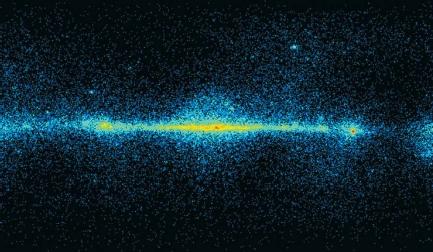
The known universe, and what the big bang caused...
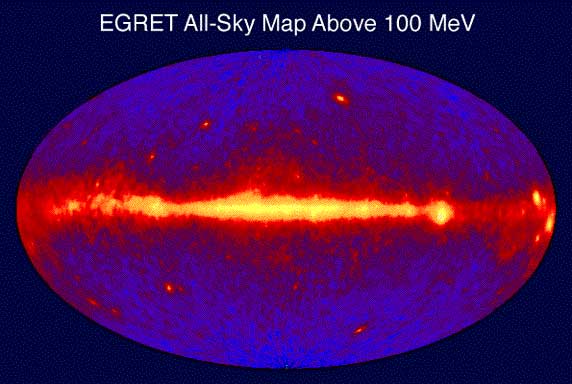
The part in red... those are GRB's.
Last edited:


- Joined
- Dec 13, 2008
- Messages
- 831
Gee thanks BananaCannon, now that I've watched that video I suddenly feel very small Thanks for the info & pics though.
Thanks for the info & pics though.
- Joined
- Jan 22, 2011
- Messages
- 77
I recommend Carl Sagan to everyone... regardless of whether or not you are interested in science, philosophy , or both.
He was a great man
I mean, why else would people remix him xD
[ame=http://www.youtube.com/watch?v=zSgiXGELjbc] Awesomeness Inc.[/ame]
He was a great man
I mean, why else would people remix him xD
[ame=http://www.youtube.com/watch?v=zSgiXGELjbc] Awesomeness Inc.[/ame]
note(must.get.a.gf.by.then!)
Hey there good lookin'.


Hey there good lookin'.
Do we need to have that talk again, Vexx?
How many times do I have to explain it?
Boys don't like you...because...Well...
Look, you're not girl OKAY? Gosh!
x3



I agree with the romantisism of the whole event, maybe another baby boom generation /bomchickawahwah
Read below to know what our sexy new sky will look like.
sure, but not locally. At least not in the history of human life. The closest was in 1054 where a star somewhere in the Crab Nebula exploded, being visable in the daytime on earth for about a month. Its was nothing major however, because that star was 10 times farther away than this star.
Must....take....thousands of pictures....!
I thought it would be minor, like an XL star in the sky, but holy crap!
Read below to know what our sexy new sky will look like.
Stuff like this has happened before.
sure, but not locally. At least not in the history of human life. The closest was in 1054 where a star somewhere in the Crab Nebula exploded, being visable in the daytime on earth for about a month. Its was nothing major however, because that star was 10 times farther away than this star.
According to the calculations of astronomers, after the explosion, the brightness of Betelgeuse supernova within a few days will increase by more than 10 thousand times and will reach an estimated apparent magnitude – 12-13, which is approximately equal to the brightness of the full moon. This means that within the next few months, Earthlings will see the sky clearly visible and in the afternoon drive, painted in blood red. Night would be much lighter, but the visible light would be quite unusual. Brightness in about a month will gradually decrease and for up to one year, an unusual new star in the end will disappear in our sky. And the place exploded star in a few decades, astronomers can watch the beautiful nebula is gradually expanding in all directions at speeds of hundreds of kilometers per second. This spectacle will be available even amateur astronomers have a relatively weak telescopes, and will last for several thousand years.
http://scienceray.com/astronomy/what-to-expect-earthlings-from-betelgeuse/
Must....take....thousands of pictures....!
I thought it would be minor, like an XL star in the sky, but holy crap!
Last edited:


