


- Joined
- Mar 5, 2009
- Messages
- 8,205
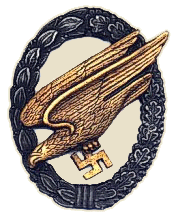
In March of 1944 in the north western Champagne-Ardenne region of Reims France, the city famous for it's religious historical monuments such as Notre Dame and the Saint Remi Basilica, the 5th Fallschirmj?ger Division was formed. It consisted of troops of the Fallschirmj?ger-Lehr-Battalion III, and contained the 13th, 14th and 15th Fallschirmj?ger Regiments, along with the 5th Fallschirmj?ger Artillery Regiment. Shortly after its formation, the division was transferred to the area surrounding Rennes, France. In Rennes, they continued training and preparation until early June when the Allied invasion of Normandy (D-DAY) took place. The 5th Division was not ready for combat, and so only its 15th Fallschirmj?ger Regiment was transferred to the front where they were strategically placed in the hedgerows of St. Lo and Aire on the Vire River within the lower Normandy farmland region. Following the allied push off of the beaches, "Though outgunned and outnumbered, the Germans were greatly aided by the terrain of the so-called Bocage. A US Army report describes it thus: "But the Germans' greatest advantage lay in the hedgerows which crisscrossed the country everywhere, hampering offensive action and limiting the use of tanks. An aerial photograph of a typical section of Normandy shows more than 3900 hedged enclosures in an area of less than eight square miles. Growing out of massive embankments that formed dikes up to 10 feet high, often flanked by drainage ditches or sunken roads, the hedges lent themselves easily to skillful organization of dug-in emplacements and concealed strong points." St. L? was the hub of a road network that spread in every direction, and thus had to be taken."

Following two months of extremely brutal combat in the hedgerows and after the British, Canadians and Americans had secured the fanatically defended city of Caen they began pushing south to the town of Falaise. Hitler meanwhile ordered a counter attack with the forces commanded by General Marshal Kluge against the American forces near Avranches but had to be postponed until August 11th. "A concerted attack on Falaise started on August 7th at 23.00. Over 1000 Allied bombers dropped 5,000 tons of bombs on German positions on the approaches to Falaise. Over 700 artillery guns supplemented the attack. Behind the artillery’s rolling barrage, 600 Allied tanks advanced as part of Operation Totalize. The Allies had to cover 15 miles to get to Falaise and by August 8th they had covered 8 miles, constantly pushing back the Germans.
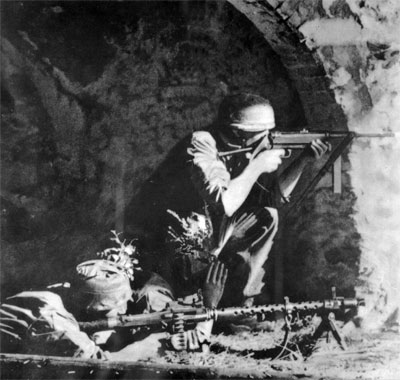
As a result of this success, Kluge postponed the counter-attack against Avranches until August 11th with Hitler’s agreement. While the Germans were being pushed back in the north, they were also being pushed back in the south by the Americans. They were effectively being driven into a pocket – hence the term ‘Falaise Pocket’." Remnants of the 5th Fallschirmj?ger division were encircled in the Falaise pocket, which also became famously known as the Falaise Gap! Very few were able to escape as Montgomery and his British forces, along with the Canadians formed a suffocating pincer.
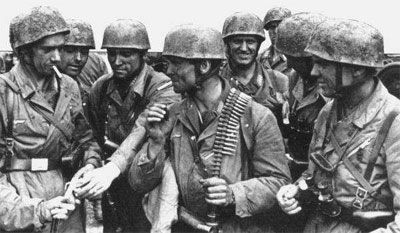
Following the terrible massacre of German forces in the Falaise Gap, what was left of the 5th was formed into a "Kampfgruppe" (known as any type of combat group, which usually employed a combination of tanks, infantry and artillery elements organized for a particular operation, usually in a battalion sized formation). The newly formed Kampfgruppe retreated toward Trier in the German Eifel area. (The Eifel is a low mountain range in western German and Eastern Belgium). The remnants of the 5th then took part in a battle for the Wallendorf bridgehead which was a short battle in which it was reinforced by elements of the Polizei Battalion along with the 2nd Panzer and Panzer Lehr Division and was able to drive the Americans back on the Luxembourg side of the Our River which borders Germany and Belgium.


The Division (now only 1000 men strong) continued to fight defensively under Generalmajor Ludwig Heilmann, but by mid-March 1945, after being once again defeated at Pr?m, were captured near Nurnburgring. Some elements, for the most part consisting of Fallschirmj?ger regiment 15 and the 5th Pioneer battalion managed to retreat to mid Germany, but it was at this moment in history where the division ceased to exist.
Article By: you dig?
_______________________________
[link="http://www.edge-gamers.com/forums/showthread.php?t=217440"]
 [/link]
[link="http://www.edge-gamers.com/forums/showthread.php?t=217440"]
Last edited by a moderator: