



- Joined
- Dec 6, 2010
- Messages
- 2,537

In early 1942, Life Magazine ran an article on a new type of American soldier that was being introduced to the military. The Paratroopers were, as Wild Bill Guarnere from easy company of the 101st Airborne, 506th P.I.R. would state later in his life, "the creme of the creme". These men (all volunteers) were All Americans and in training were pushed to their limit in every way possible. Only 10 percent who went into training were awarded their jumpboots and wings. Other paratroopers would simply state that they were proud to be part of the most elite units the United States had ever seen and crazy enough to jump out of a perfectly good airplane.
In 1942 in the deep south at Camp Claiborne, Louisiana, the first ever airborne division was born. The 82nd when introduced was commanded by Major General Omar N. Bradley and would later that year be under Major General Matthew B. Ridgway and be relocated for the new airborne training at Fort Bragg, North Carolina. Personnel from this division at this same time were also divided to complete the formation of a second airborne unit which became known as the "screaming eagles" of the 101st Airborne Division. At Fort Bragg, normal civilians were thrown into the most vigorous training in the US military and were the pioneers of the sky, leaping from C-47 transport planes and were suspended from a self packed parachute!

When the spring of 1943 came along, the 82nd airborne division was the first airborne division to be sent overseas to North Africa. This would become their staging point for their combat drop and assault on the underbelly of Hitlers Fortress Europe. From Kairouan, Tunisia on July 9, 1943, Colonel James Gavin and his 505th Parachute Infantry Regiment along with elements of the 504th PIR were dropped into areas surrounding a target airfield in the northeast of Gela, Sicily (Operation Husky). Units were scattered to hell and back, but were still able to complete all of the objectives they had been given as well as link up with the Big Red One (the 1st Infantry Division). Two days later the rest of the 504th parachuted in to join the force. The 504th ran into some terrible misfortune and had to deal with large amounts of German and Allied (friendly fire) anti-aircraft fire because of large amount of miscommunication between ground and commanding forces. The entire goal of this operation was to gain control of Mediterranean sea lanes and it was done victoriously and along with that it toppled Benito Mussolini from power. This was the beginning of the Allied Invasion of Italy.
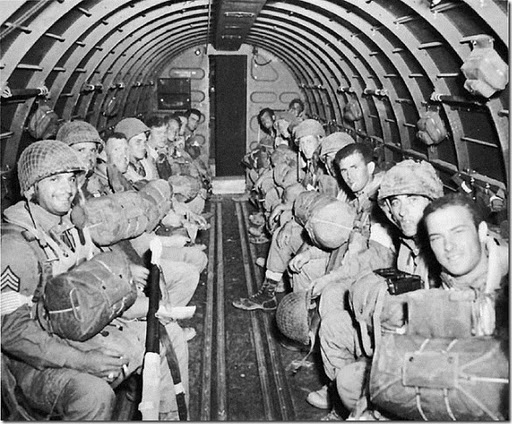
On September 13, 1943, in an attempt to rescue General Mark Clark's 5th Army from being pushed by the Germans back into the sea, the 82nd made a night drop into the sea city of Salerno. Nicknamed "The Oil Drum Drop", oil drums filled with gasoline were ignited to mark the ever shrinking dropzone so that the 504th PIR would be able to parachute in and support the 5th Army. The force continued to fend off the German attacks and on the following night, the 505th PIR was dropped in the vicinity of the same dropzone to reinforce. The 325th Glider Infantry Regiment also joined and once the beachhead was secured the division fought toward Naples, which it reached October 1, 1943. Following Naples, the 504th and 376th were detached and became part of the 36th Infantry Division. They became "leg infantry" and fought through the capture of Gallo on October 29th and then in the hill to hill battles of the Winter Line.

Anzio, on January 22nd and 23rd 1944, the 504th PIR landed against extremely heavy resistance. Unlike the previous jump into Sicily, which resulted in a high number of casualties, the 504th of the 82nd was assigned to land by sea at the Southwestern coast 6 miles east of Anzio. The majority of the time spent in Anzio, the 504th were thrown into the defensive in a style of trench warfare that had been seen in the first world war. "It was during this battle that the 504th acquired the nickname "The Devils in Baggy Pants," taken from the following entry found in the diary of a German officer killed at Anzio: American parachutists -- devils in baggy pants -- are less than 100 meters from my outpost line. I can’t sleep at night; they pop up from nowhere and we never know when or how they will strike next. Seems like the black-hearted devils are everywhere…"
During the early months of 1944, the division was shipped up to England to prepare for Operation Neptune, the airborne attack on Hitler's western Europe.
During the DDay invasion, the 3 parachute regiments (now the 505th and newly added 507th and 508th) and a glider regiment landed between the French towns of Carentan and Ste Mere-Eglise. They took strong opposition from German forces in the area and were pressured along the Merderet River. At La Fiere, a bridgehead was secured by the 325th Glider Regiment and "It was during this action that Pfc Charles N. DeGlopper single-handedly defended his platoon's position and subsequently was awarded the Medal of Honor for his heroism. " The 82nd took part in many other clashes with the Germans including capturing the Montebourg Station, Hill 131 and HIll 95 over La Haye-du-Puits. "By the time the All-American Division was pulled back to England on July 13, 1944, it had seen 33 days of bloody combat and suffered 5,245 paratroopers killed, wounded or missing. The Division's post battle report read, "...33 days of action without relief, without replacements. Every mission accomplished. No ground gained was ever relinquished."

After Normandy, the 82nd merged with the 17th and 101st Airborne Divisions to form the newly organized XVII Airborne Corps. At this moment in time General James Gavin was promoted to lead the 82nd. During Market Garden, the 504th (which had been too weak to take part in the Normandy invasion) rejoined the 82nd forces and the 507th formed in with the 17th Division. Though Operation Market Garden was failed, due to the neglect of high command whom had called everyone to expect only kids and old men as the German Occupation force, the 82nd was able to capture the Maas Bridge, the Maas-Waal Canal Bridge (which with force they were able to secure) and the Nijmegen-Groesbeek Ridge. Arnhem was short lived and the operation was called off. The Allies would have to find another way into Germany.
The unexpected German counterattack through the Ardennes forrest (which became famously and historically known as the Battle of the Bulge), was a shock to all allied forces. The 82nd attacked fiercely in the Vielsalm-St. Vith region and were able to force the german spearhead back across the Ambleve River only a day after the offensive had begun. In other areas of the Ardennes region they also dug in deep and fought back against the counter-attacking German forces and later crossed the Roer River. The division took part in what was known as security duty in Cologne, where they basically performed as Military police at roadblocks and outposts. During April of 1945, the division pushed toward the German border and the entire German 21st Army surrendered to the Division on May 2, 1945.

The men of the 82nd, who volunteered to be with the best of the best, had fought long and hard through every aspect of the european theatre of operations against Hitler's war machine down to the very end of the war. They had proven to the world they were elite and that they were indeed worthy of having the title "All American". "In Berlin General George Patton was so impressed with the 82nd's honor guard he said, "In all my years in the Army and all the honor guards I have ever seen, the 82nd's honor guard is undoubtedly the best." Hence the "All-Americans" became known as "America's Guard of Honor."
Article By: you dig? (Official DoD:S Historian)
[ame]http://www.youtube.com/watch?v=2u7UibDRiOg[/ame]
_______________________________
[link="http://www.edge-gamers.com/forums/showthread.php?t=217440"]
 [/link]
[link="http://www.edge-gamers.com/forums/showthread.php?t=217440"]
Last edited by a moderator: