ITT I attempt to review every video game I've ever played.

Joined
Mar 24, 2011
Messages
1,488
Last edited:
Harry_Potter_and_the_Chamber_of_Secrets_Coverart.png


Harry Potter and the Chamber of Secrets​

I wanted to start with a game from my childhood. Of course, I actually went back and played the game so I wouldn't look at it through nostalgia goggles. Still enjoyable, but definitely room for criticism.

NOTE: This is based off the Gamecube version. Based on footage I've seen, the Gamecube and PS2 versions are very different, so I'll look at it if I ever get the chance.

Story: You seen the movie? You read the book? Yeah, okay, now forget all that because this is like Harry Potter and the--oh, wait, its over. Some things are fleshed out and other things are changed or removed entirely. For example, Dobby does not exist. Gilderoy Lockheart isn't ousted as a fraud in the Chamber of Secrets. To make up for it, other things are fleshed out, such as some nonsense in Diagon Alley to find Ginny's lost things, going into the restricted section to find a book for Hermione, and challenge chambers, which I'll cover later. Despite that, the point of the story gets across and many of the major plot points still exist.

Graphics: Well, since this game released in 2002, don't expect much. I also played it in an emulator with a ton of graphics enhancements, so I probably don't have a full picture of how good or bad it looked fourteen years ago. That being said, without aliasing, upscaling, and other things in my way, I can see what the developers intended, and it's safe to say they tried.
ZX2RWFk.png
There's nothing that's particularly impressive or wowing, but everything is safely stylized, and all the characters look like their movie counterpart.
tsU4U2F.png
...okay, maybe not all of them. That's Tom Riddle, by the way, in case you couldn't guess. Still, the game manages to keep the warm browns/golds and cool blues like the movie did.

Sound: The voice-acting is pretty hit-or-miss. Despite this game being Chamber of Secrets, a lot of the children sound like they did in Sorcerer's Stone. They're also all very loud. Honestly, some of Malfoy's lines sounds like his VA was screaming into the microphone. As for the other voices...meh. Some sound like bad impressions, some sound decent. There's really very little to praise or fault. As for the soundtrack, however...wow whee. It definitely sounds and feels like Harry Potter, while providing some tense atmosphere during portions of the game. There are some parts where I feel like it doesn't work, but those are few and far between the best parts. My favorites are:

-Title Screen (Parts 1 and 3)
-Stealth Sneak
-Hogwarts Castle (Day)
-The Library
-Library Tower
-Following Ron

I can't link them because the forum will automatically turn them into full-blown YouTube video embeds, so you'll have to Google if the need strikes you.

Gameplay: The game itself is relatively formulaic and splits itself into five "day" and "night" segments. During the days, you will go into challenge chambers and play Quidditch. During the nights, you will sneak around Hogwarts. Most of the major plot points (Polyjuice potion, Aragog, etc.) take place during the nights. I mentioned the challenge chambers earlier and I feel they deserve some recognition, since I've always seen them as the cornerstone of the game. Basically, you start with two spells, Flipendo and Lumos. You go into challenge chambers to learn Expelliarmus, Avifors, and Incendio, which are for defense, transfiguration, and fire, respectively. You also learn Skurge, Diffindo, and Alohamora on other escapades at night. How are the chambers themselves? Well...
MVTzOoO.png

Gfy1wfA.png
They're all very stylized and actually have some neat puzzles. Since it's a video game, I can see why they made the obstacles and puzzles a little more dangerous. Of course, you have to remember that you're sending 11-17-year-olds into these challenge chambers, which makes me wonder about some of these things.
bpnm9kV.png

BmL3xAv.png
Another big part of the game is, of course, Quidditch.
sejYxWc.png
You're forced to play Quidditch at least three times, but you can play it as many times as you want during a day. The flying itself is a little rocky and can be overly sensitive when you're close to the snitch but the mechanics make sense and it's otherwise very, very fun. Chamber of Secrets is also a little open-ended in a sense. If you're sneaking around prefects (which is REALLY not worth talking about in and of itself) and get caught, you'll find yourself losing house points.
Picv3Cd.png
House points are counted up at the end of every day and every night. Slytherin will either always be a close second or have a lead over Gryffindor, as is their need, and they can go so far as to even win the House Cup. Although, the game actually warns you against this, giving you an opportunity to basically do what Dumbledore did at the end of The Sorcerer's Stone.
B6Fs448.png
Finally, there's collectibles. Doing various activities around the castle, such as completing lost-and-found and doing minigames, you will be rewarded trading cards. I would've done this, but the game actually locks some away from you if you don't have a Gameboy Advance and a copy of CoS for it.
d5eZhir.png

​

Lasting Appeal: While it's possible to do bad and make Slytherin win, the game itself is short and linear. There's very little reason to replay it outside of trying to 100% and get all the trading cards. Despite that, it's a short game and wouldn't make bad Let's Play material or just a good way to chill and have a laugh with friends. For me, it was a core part of my exposure to gaming and every second of it holds a special place in my heart.

Bottom Line: A fun enough movie tie-in game that manages to be enjoyable while still remaining simple. Nothing to write home about, but I recommend giving it a shot.
 
Last edited:
I actually just finished replaying The Chamber of Secrets after finding it in my parent's house. Hilarious fun for a few hours. Obviously not the best as its based on a movie and all, and hasn't aged well, but some fun for a Harry Potter fan
 
Wow, that's a pretty neat review! I've never played the game before but you seemed to have summarized it pretty well. I hope every game you review can be as long as this review, I like the effort put into it :-)
 
Wow, that's a pretty neat review! I've never played the game before but you seemed to have summarized it pretty well. I hope every game you review can be as long as this review, I like the effort put into it :-)
Thanks a lot! I can't safely say they'll all be this detailed (with the pictures and such), but when it comes to word count, that'll definitely be a focus. I think pictures might be for older or less-heard-of games. If I review Fallout 4, everyone knows what that looks like.
Hahaha i remember some of the harry potter games. Good times
I'm planning to review more of them, since I did own them all at one point.
 
Right on man, I wish you the best of luck with this. Oh, also requesting the original S̶t̶a̶r̶c̶r̶a̶f̶t̶...actually just the original Mass Effect.
 
Last edited:
header.jpg

Life is Strange​

A five-part episodic game about time-traveling lesbians surrounded by characters who are all cliche archetypes who must come to terms with their power? What could possibly go wrong?

Story: Okay, so it's a little more complicated than that. I will try to be spoiler-free for recent games and just stick to basic plot points. Anyway, yes, this game is split up into episodes, as is the want of the gaming industry right now, and every episode gives you decisions that impact the story. Like most games of a similar caliber, these choices impact how certain events unfold and your relationships with characters that may make it easier or harder for you down the road, but the story as a whole remains mostly unimpacted and the plot twists remain the same. The story itself develops like a photograph: Slow, but satisfying. Episodes 1 and 2 are certainly a bit of a drag as they establish the world and characters, while Episodes 3-5 really get to the nitty-gritty.

The game opens to Max Caulfield, a student at Blackwell Academy, discovering she can rewind time to save a girl's life. From there, she finds herself involved in a massive conspiracy surrounding the fictional town of Arcadia Bay and Blackwell Academy. The story hinges on her time-traveling power to allow her to quickly go back in time to solve a puzzle or even to completely change the past. There are roughly four "big" decisions in an episode that WILL impact the story going forward, and they typically aren't easy ones, due to the story covering topics most videogames stay away from, mostly because the game centers around teenagers. Parental abuse, bullying, suicide, sex, and more are covered, but from a sympathetic angle. The game doesn't play like a bad PSA from the 90s, the teenagers are written like they're actual people.

Graphics: While it has UE3 as a very strong backbone, Life is Strange manages to be beautiful while keeping a relatively low level of detail. All of the game's textures are handpainted and the characters look cartoony in a sense. The whole world feels like an art piece. I did notice an odd issue where, during cutscenes, the camera and characters seemed to have a small jitter to their movements. I chalked it up to a bug with the mocap, so I'm willing to let it slide. There were also a lot of issues with characters lip-syncing to their dialogue. This seems to be a common trait in episodic choose-your-path games and I really can't understand why.

Since the main focus of the game is Max's rewind, the game wants your time-traveling to look special, and it does. When rewinding, the world fuzzes, bleeds, and leaks like a polaroid while your actions play back to you. The world also freezes and bends as you're tasked with making a big decision. It's the game's way of telling you that you're doing something important. The HUD (or lack thereof) also looks hand-drawn and feels alive. All of the drawings, arrows, names, what have you, seem to dance, giving the game a lighthearted air (which is needed).

Sound: The game mostly uses music from indie folk artists, but Life is Strange's score alternates between two genres and feels of music. The first is soft acoustic guitar and percussion, paying homage to indie folk. This is really only used in the menu and some parts of the game, while the rest is licensed music. The other half is more techno, with tense bass and beats to keep the action moving. This music is, obviously, played in tense moments and during moments of important decisions. The contrast is stark, but needed. It keeps Life is Strange's two sides separate. Personally, I'm not the biggest fan of indie folk, and I kept wondering what the game would sound like if Olafur Arnalds did the soundtrack. Look up the Broadchurch main theme if you want to know what I'm talking about.

Gameplay: The game would be a third-person walking simulator with some puzzle action if it weren't for the rewind mechanic. It forces you to think about puzzles in a different way, since rewinding time is relative to Max, so she doesn't move and her inventory doesn't change. For example, in Episode 3, there's a puzzle where you have to break into the principal's office at night. The solution is to construct a pipe bomb, blow open the door, go inside, rewind, and open the door. It's a little mind-bending to think about but the mechanic itself works really well. You can also rewind decisions if you do it immediately, even big decisions in case you regret it. However, likely because of time constraints, the game doesn't pull an Undertale and keep freakish track of how many times you do a certain thing. In Episode 2, it's possible to make Chloe shoot herself on accident. It's also possible to see her get hit by a train. Many times. My problem with these is that Max doesn't appear fazed by watching her friend die over and over. This doesn't become apparent until later in the game where it's convenient for the narrative, where the game centers around Max being haunted by what she's seen in alternate realities. That being said, the game makes great use of the time travel mechanic and it doesn't feel like a useless gimmick. DONTNOD's last game, Remember Me, had a similar mechanic with changing memories, but you only get to do it a handful of times. Meanwhile, rewinding can be done at any time, it's not limited to certain parts.

Lasting Appeal: Replayability, the game. While the game itself will always resolve in one of two ways, the game itself is charming and it does a good job of comparing your choices against what other players did. And even then, the story and characters are worth talking about and the fandom is alive and kicking.

There's also a dating sim based off Life is Strange, if you're into that.

Bottom Line: While the basic premise feels laughable, Life is Strange is an emotional rollercoaster of a game that manages to be interesting, albeit more in the second half than the first. It helps me keep faith in interactive storytelling.
 
Last edited:
Please review any game of the souls series. If you haven't played them, could you do binding of isaac? Great work with your first two, keep it up!
 
f4-logo.JPG

Fallout 4
​

The long-awaited sequel to Bethesda’s smash hit post-apocalyptic RPG with a story with less coherence than a five-year-old’s imaginary friend and sort-of sequel to Obsidian’s beloved spin-off is here. How will it stand up to the likes of The Witcher 3?

Poorly.

Story: As is tradition in Fallout games, your character has a vague-ish past in which some tragedy happens where you’re sent out to prove you’re a man and get yourself involved in some big conflict that mirrors the conflict that blew up the world because war never changes. I honestly feel like Bethesda has lost track of what Fallout’s tagline was supposed to mean. Black Isle’s Fallout games were fighting over people to repress evil, Obsidian’s New Vegas was fighting over supplying power to an entire desert, Bethesda’s Fallout 3 was some unholy combination of the two, and Fallout 4...just feels anticlimactic. The story, as a concept, I really love. The game opens by showing us glimpses of the world before the bombs fell, which is really a first for a Fallout game. This is actually critical to the plot, as you play as one half of a loving couple who, because of the husband’s veteran status, have unconditional access to the nearby vault, Vault 111. The alarms begin to sound and you and your husband/wife make a mad dash to the vault, just barely making it in. However, while every vault seems innocent, they’re secretly designed to mess with the inhabitants in an attempt to see who would be better suited to fix the world when the radiation faded. Vault 111, fitting in perfectly, turns out to be a cryogenic vault. Your characters are tricked inside and get frozen, only to find yourself unfrozen 200 years later with one dead husband/wife and a missing son. From there you set out on your crusade across the wastes to solve the mystery and find your son. I won’t spoil the big twist because, surprisingly, it’s a really good twist from Bethesda. It really pulled the rug out from under me.

Unfortunately, it’s after this point that the story loses momentum. Throughout your travels, you see people who are paranoid and terrified of “synths.” A synth is a robot that can perfectly mimic a human, based off old-world technology. Surprising when Bethesda remembers their game takes place 200 years after Fallout 2. Anyway, you meet a bunch of paranoid people who are scared of the synths and their maker The Institute because, as they will tell you, people will disappear and be replaced with synths. Why, I don’t know. The game is also nonlinear, to a point. It’s not quite New Vegas levels (which there is no excuse for), but you DO get to side with one of four factions. I went with the Minutemen, seeing how they wanted to unite the wasteland and rebuild with a people’s republic. The problem is, this doesn’t make a lot of sense, as siding with them will get them involved with the Institute and its destruction, which they have no reason to care about. Fallout 4 also allowed you to play the past the ending, so the destruction (or not, depending on your choices) of the Institute feels very anticlimactic. All that’s left is to do sidequests and wander a world which you’ve probably seen most of by that point.

The story itself is great, just executed poorly in the third act.

Graphics: I have never played a Bethesda game for the graphics, but Fallout 4 looks good. The world has lots of foliage, characters and animations look better, and post-processing can give it some extra oomph. However, there’s two problems. First off, Fallout 4 does not run on a new engine. It uses the same engine Skyrim used in 2011. So, Bethesda’s Creation engine (which is based off Gamebryo, an even older engine) is effectively five years old. For a game that’s technically been in development for seven years, that just doesn’t sit right. Bethesda’s brand new, AAA game is running on an old renderer on an old engine that can’t handle 32-bit architecture. Second off, Bethesda was in a bad spot with their release time as The Witcher 3 was still fresh in everyone’s mind. While whether Witcher was downgraded is a topic of debate, but it still looks beautiful. Fallout 4 still suffers from some ugly textures and blocky meshes. In any case, Fallout 4’s Commonwealth is Bethesda’s best game world ever. It looks the best and has plenty of entertaining things to find.

Sound: Fallout 4 was polarizing before release due to the new, fully-voiced protagonist. Every line of dialogue is said by your character and s/he even makes some exclamations and remarks when hacking, lockpicking, and even doing drugs. It’s a nice touch, but when it comes to actual dialogue, the female VA definitely delivers some lines better than the male VA, and vice-versa. For example, there’s a quest in which you must go around, pretending to be a comic book character. The male VA does this pretty well, but the female VA falters. However, she steals the show when you find your son. A lot of the characters and companions also sound distinguished and, in some cases, deliver A+ voice acting. If you want a companion you’ll love to hear talk, stick with Piper.

The soundtrack is scored by Inon Zur, whose past credits include Fallout 3, New Vegas, and Skyrim. Fallout’s music still sounds like Fallout, with industrial-sounding percussion and an arrangement based mostly off strings. The radio still relies on swing and other music from the 20s-50s. That just happens to be my favorite genre of music, so I can’t complain. The score, though, I was partial to. In towns and near stores, it started to sound a bit like Skyrim. Not that I minded, but the feeling of fantasy and adventure felt lost on a game that’s about how messed up the world is. The other thing that irked me about the score was, when I got to the Institute, it started sounding like the soundtrack to Starbound. Again, not a problem, since I like it, but very out of place. In other parts, the score works really well. Walk around Sanctuary and Red Rocket at night to trigger my favorite part.

Gameplay: This is where I’m very, very, very disappointed in Bethesda. Any Elder Scrolls player knows that they’ve been dumbing down the RP in their G for a while. In exchange for more expansive worlds, gameplay became shallow. In Fallout 4, I’ve split gameplay into three different categories: Gunplay, storytelling, and roleplaying. I’ll tackle them one at a time because I have a good amount to say about all of them.

Gunplay has never been better in Fallout. New Vegas was a step in the right direction, but Fallout 4 showed how much Bethesda was prepping for DOOM. The guns feel tight and easy to aim. There’s actually very little to say about it other than that they’re good. However, this created a problem for me that I’ll touch on in a moment.

I’m sure you’re wondering how storytelling belongs in gameplay and my answer is simply that it’s the core of Fallout. Fallout 1 and 2 may have had a single “good” ending and “bad” ending, but the little other bits of the ending that showed how your choices affected every settlement and group of people you did things for. Fallout: New Vegas, developed by veterans of Black Isle, took this to the next level and made the ending nonlinear. The central conflict can resolve four different ways, and those are each subdivided into three different forms depending on the player’s karma and reputation. These choices are not only cemented by whom you did or did not kill, but your dialogue choices. New Vegas had very rich dialogue and the player character could really say whatever he wanted. It even gave you the rare ability to say “no” to people, something Bethesda can’t quite catch on to.

Speaking of Bethesda, what’s THEIR dialogue system like?

nVCQ4QZ.jpg


Okay, this is cheating a bit, so let me explain. Fallout 4’s dialogue system takes after the same one from the likes of Mass Effect, Dragon Age, and even Deus Ex...and does it poorly. Even in Mass Effect, where you play as an actual character with actual development, you still got the ability to be evil or just a jerk. In Deus Ex, the dialogue options themselves were truncated, but mousing over them gave a more detailed explanation. Fallout 4 doesn’t do this, either. Instead, we’re stuck with a lazy, four-option-only dialogue system that turns your character into more of a yes-man than Yes Man. And do you know what the REALLY sad part is? Deus Ex ALSO had four dialogue choices at a time...and did it better.

wDEo1Af.jpg


Now, how did I get the screenshot? There are mods that show you the full dialogue of your choice, instead of just a basic outline. Here’s what it looks like without the mod.

fallout-4-review-absurdity-in-dialogue-no-choices.jpg


The picture is low-resolution, but bear with me. These options are all the same thing: Yes. Even the “no” option is yes. The other option is information that you already know. It’s absurd to think about, especially when Bethesda’s last game, Skyrim, sold more and was received better than Fallout 4 and used the exact same dialogue system as Fallout 3 and New Vegas. I just can’t fathom what the rationale behind this is.

Up next is roleplaying, and this is perhaps my biggest issue with the game. Shallow dialogue options are fine, but at least give me some choice. I think my biggest problem with Fallout 4 was that I was not allowed to be evil. I was also not allowed to fail quests. Hell, I couldn’t even say no to quests! Every quest also follows a specific formula, which is the problem I had with the really good gunplay: Go to X, kill Y, find/talk to Z. Literally every single quest in the game forces you to kill someone or something. It’s impossible to do a no-kill run. I know that shouldn’t be a requirement for every game, but it shouldn’t be too much to ask from an RPG where the predecessor did all that and more. The game actively railroads you towards violence to the point of three of the four endings involve you blowing up the equivalent of a nuclear bomb. I say three, more like one of two. It just changes based on what faction you liked more. It honestly made me bored. However, there is saving grace. Two quests, while involving killing, break from this formula and are genuinely interesting, funny, and felt like you were accomplishing something other than cleaning out a random raider encampment or school infested with pink ghouls. Those two are The Silver Shroud and The Last Voyage of the USS Constitution. I won’t spoil either of those quests, but they’re the diamonds in the rough.

While it doesn’t fit into my three gameplay categories, I wanted to mention skills. Perks, skills, and traits are now gone. Traits were already gone in Fallout 3 (and subsequently brought back in New Vegas) but seeing them gone again makes me think Bethesda just hates giving your character any sort of aliment. Perks and skills are now merged into singular perks that can be upgraded every time you level up. Much like Skyrim, you take one perk at a time, and every perk has ~3 ranks that make it better. I did like that the perks were tied a little closer to your SPECIAL stats than in previous games, but Bethesda’s idea was to give you a lower amount of points to divide amongst SPECIAL in the beginning and allow you to put one point into a SPECIAL stat as opposed to a perk. In theory, this means that you could give your character perfect 10 stats and, with enough grinding, unlock and max out every single perk. Oh, yeah, I didn’t mention, the game doesn’t end after the climax of the story, like literally every other Fallout game has. You’re free to pursue any side quests and explore any locations you missed during the story and, inevitably, become God due to all your leveling up. Or you could do settlement building, which is so boring, tedious, messy, and undocumented I did not touch it.

I did like the crafting, though. Unfortunately, I did not touch it until about halfway through the game. It’s a good system, though. Too bad it relies on perks and not skills.

Lasting Appeal: If the prospect of the settlement building enthralls you, then there’s a good amount of reason to keep coming back to Fallout 4, but after the story, you’ve already seen so much of the world that there’s really no reason to keep playing. Remember how, in Half-Life 2, Ravenholm was such a spooky place but once you went through it, you felt triumphant knowing you’d never have to do it again? Fallout 4 is the opposite. There’s no triumph, there’s no climax, and the story is so linear that an on-rails shooter feels more spontaneous. It wouldn’t hurt to wait until the modding tools get released to pick up this game. At that point, you’ll probably get some nice features added that make the game a little more lively.

Bottom Line: Fallout 4 is fun and is definitely for you if you enjoyed Fallout 3. However, if you wanted a New Vegas 2, you will be extremely disappointed. It’s still fun and the first half of the story is interesting, so if that sways you, pick it up. In the end, it’s more Fallout.
 
Last edited:

header.jpg

Undertale​

Undertale is a good game.

…

Sigh, look, this game is just IMPOSSIBLE to review. Undertale’s formula to success is the player knowing nothing about it going in, and honestly, that’s the best review I can give. That’s not trying to save you from utter badness, don’t worry, I’ve got bad games in the pipeline.

This game is absolute perfection. I can not fault anything about it that isn’t a problem with the genre or medium of interactive entertainment. After spending so much time in Fallout 4, Undertale felt like a breath of fresh air. It’s entertaining, the music is awesome, and the story has so many branches and paths, trees get jealous.

If I had to give you ONE game to play before you died, it’d be Undertale. Torrent it, buy it, get it from a friend, I don’t care, but PLAY it. You’ll see why I don’t have to write a review.
 
Last edited:
I love your fallout 4 review. Huge fan of all the fallout games, but when it came to fallout 4, well, while it felt like a fun game, it didn't feel like a fallout game.
 

header.jpg

Undertale​

Undertale is a good game.

?

Sigh, look, this game is just IMPOSSIBLE to review. Undertale?s formula to success is the player knowing nothing about it going in, and honestly, that?s the best review I can give. That?s not trying to save you from utter badness, don?t worry, I?ve got bad games in the pipeline.

This game is absolute perfection. I can not fault anything about it that isn?t a problem with the genre or medium of interactive entertainment. After spending so much time in Fallout 4, Undertale felt like a breath of fresh air. It?s entertaining, the music is awesome, and the story has so many branches and paths, trees get jealous.

If I had to give you ONE game to play before you died, it?d be Undertale. Torrent it, buy it, get it from a friend, I don?t care, but PLAY it. You?ll see why I don?t have to write a review.

Second this. Buy it, play it. Don't watch a play through of it on youtube. It's a pretty cool game to play on your own.
 
header.jpg

The Binding of Isaac: Rebirth
​

I don’t know what a rougelike is, but apparently this is one.

Story: The plot is a harbinger to the old NES/SNES days where the plot was almost an afterthought. There’s a basic setup to the gameplay, but other than that, the game is almost just an arcade game. Regardless, you play as Isaac, the son of a single, Christian mother. She hears God’s voice speaking to her and she is commanded to kill Isaac. Running from his mother, Isaac jumps into a trapdoor beneath the carpet in his room. The plot and setup parallel/parody the actual Binding of Isaac from Genesis 22. Regardless, the story is not the focus of the game.

Graphics: It must be some kind of unspoken rule of indie games that they must all have either pixel graphics or some sort of super-artsy design. Binding of Isaac opts for the former, and does a good job. It’s a little too detailed for the likes of a NES or SNES, where other games like Shovel Knight try to emulate them to a tee, Binding of Isaac tries to maintain a higher level of detail. This comes into play pretty well, as it allows for a lot of animation and variation in the game.

One of my favorite touches with the graphics is how your character changes based on what powerups you have and how many. What can you look like?

tr5pE0W.jpg


That. You look like that.

Sound: The game relies on squishes, squelches, and grunts of pain from Isaac and monsters to make the sound. Aside from that, music is constantly playing. It has electronica roots, but guitars carry the melody on most parts of the game. I’d rank it as one of my top game OSTs.

Gameplay: Remember the classic Legend of Zelda? The first one on the NES? Remember the top-down dungeons? Binding of Isaac is EXACTLY like that. It’s all you do, it’s the core gameplay, and it’s stupidly fun and addicting. However, unlike Link, all of your attacks are projectile-based, and they can be altered based on what powerups you grab on your run. They can pierce enemies, home on enemies, fly faster, or cause different kinds of damage. As for the dungeon itself, they are randomly generated in every run. In Rebirth (the version of the game I own, which is a pure remake of the original Binding of Isaac), you can enter in seeds to have dungeons generated a certain way, but progress will not be saved, invalidating the run.

Lasting Appeal: Since the game is theoretically infinitely replayable, I can say I come back to this game again and again to run through a new set of dungeons. There are also multiple endings, but since this game is hard, I can’t get them. I think you unlock more the more you clear the game. Oh, well, more reason to keep trying.

Bottom Line: If you like more narrative-driven games, Rebirth is not for you. It’s a randomly-generated arcade game. However, it manages to be very fun, entertaining, and challenging. I really do recommend buying it.

(Sorry this review is so short! I’ve been drained from class projects and other responsibilities. My next reviews should be longer!)
 
Last edited:
header.jpg

LA Noire​


Let’s be cops!

Story: There are a lot of stories in LA Noire, all of which are relayed in different order from each other. The game has a lot of foreshadowing and tells you about events that took place before and during the events of the game. Two of the four main “sections” of the game also have little mini story arcs of their own, one being independent of the story while the second, and the final, tries to wrap it all up nicely, and does a very good job. This next part of the review will be somewhat spoiler-heavy, so if you’re planning on picking it up, skip ahead to the next section.

The story very much reminds me of Memento. I feel like the writers watched Memento a few times and managed to weave everything together very well. However, unlike Memento, the story is told is mostly chronological order, instead of beginning with the end. You play as Cole Phelps, a war veteran who is now a detective in 1947 LA, the year of the highest crime rate. Cole is very quick, witty, and well-read and manages to outshine most of his partners intellectually. He also always manages to land the big cases, even when just investigating burnt-down houses. It honestly gets a little silly, but I think the game does it really well. You follow Cole through five “desks” in the LAPD: Patrol, Traffic, Homicide, Vice, and Arson. Aside from Patrol, all of these desks have, at most, six cases each. Some cases are self-contained, but both Homicide and Arson have their own mini-arcs and, in the case of Arson, tie themselves into the main story. Over the course of the game, you can learn more about Cole’s past as a war veteran and, if you find newspapers hidden in certain cases, can uncover the events behind a massive drug heist and conspiracy that will wrap itself up at the game’s climax. Yes, there’s a lot going on, but like I said before, the writers tie everything together very well and don’t let anything steer out of control.

That being said, the story is not flawless. The weakest point is, for sure, the Homicide desk. While the arc is very interesting, the conclusion makes no sense and, in my opinion, invalidates the bulk of the cases in Homicide. It’s a slight nitpick and that really only affects the Homicide desk, but it’s arguably where you will spend most of your time during the game. The narrative also has to make assumptions based on how you handle a previous case. An example in the Homicide desk is where you will have to choose who to convict for murder. While evidence may point towards one, your captain will get mad if you don’t choose the other one, and punish you by giving you boring or just no cases for a while. However, the game immediately picks up in the next case with the captain pleased at your work and he immediately gives you another high-profile case. I would like to say this only happened in Homicide, but it can also happen in any other case for reasons I’ll explain later.

My flaws with the story may seem nitpicky to some, and I honestly think they are, but when your game is 100% story, you really have to avoid doing something silly. That being said, I really like the story. It’s not as high up as Undertale or Fallout: New Vegas on my list, but it’s certainly up there.

Graphics: While textures and geometry aren’t fantastic, LA Noire is an extremely faithful recreation of 1947 Los Angeles. Everything is stylized, the colors look right, and historic landmarks are inserted all over the massive world. The characters also look good, with state of the art facial-scanning technology used to expertly reproduce the faces of the actors. For a better look at the facial technology used, look up the Tech Trailer on IGN’s YouTube channel.

However, those who are looking for a breathtaking experience will be disappointed. Aside from the character models, nothing in the game was visually wowing. It all appears to be so-so. Also, as a limitation of the technology used, the game is capped at 30 FPS. Uncapping it will cause physics bugs. From both a technical and gameplay standpoint, I understand why they did it, but as a predominantly PC gamer, it bugged me. However, I urge you to look past that, since the game really plays more like a movie.

Sound: All of the voice acting is really good. I’m starting with that first because, due to the interrogations, you’ll be hearing voices a lot. Rockstar and Team Bondi got supreme talent for their characters. Fans of Mad Men will be pleased. The city also sounds alive, too. Sounds of car motors and horns, the trolleys, and trains make up the soundscape of LA. The people you bump into in the street also have some things to say about Phelps, which will change as you progress through the story, which is a nice touch.

The game’s soundtrack is also really good. It may even be one of my favorite soundtracks. Composed by Andrew and Simon Hale, the score sounds right at home with the noir setting. Relying on horns and strings, but also drums and wind instruments for certain sections, the game is certain to never break atmosphere or mood. There’s also a common leitmotif throughout most of the score. Some choices of mine from the soundtrack:
Main Theme
New Beginning, Part 3
Temptation, Part 2
Redemption, Part 2
Main Theme (Piano & Trumpet)
Chase 01 and 05
Clues 01 and 04
Casual 02 and 03

Gameplay: During a case, gameplay is divided into investigating crime scenes, driving, foot chases, shootouts, interrogating, and street crimes.

Crime scene investigation happens multiple times per case. You’ll do it a lot, but it’s far from tedious or repetitive, since every crime scene is different. You’ll find some missing car/dead body/burned house and have to look around to find clues. These clues are often important and serve as your leads. You can’t leave a crime scene until after you find all the clues, but LA Noire uses musical cues to inform you of your progress during this gameplay stage.

Driving also happens a lot. You’ll be driving to and from locations of interest, doing car chases, and driving towards reported street crimes. While the first part can be done automatically at any time, the game will force you to drive during a car chase or will prevent you from responding to street crimes if you’re not driving. These car chases don’t happen every case, but they’re usually the same: Spin out the suspect. Your partner can shoot out the suspect’s tires, but ultimately, you will have to stop the car. The game also penalizes you for causing excessive city damage and injury to pedestrians. This only affects the end of the case and has a limited, but funny, influence on the story. As for driving normally, the cars are spectacularly okay. Don’t expect GTA V levels of control.

Foot chases also happen a lot, and typically end in one of two ways. Either you will have to tackle the suspect to the ground or fire a warning shot in the air to stop them from running. There really isn’t a whole lot to say about the foot chases other than that they exist.

Shootouts aren’t too common. I don’t recall them happening in every case. At this point, LA Noire becomes a cover-based third-person shooter. There’s some ways to interact with the environment and you can pick up guns off the ground, but it feels very basic, which is good. The most important aspect of LA Noire’s gameplay isn’t how fast or well you can fire your gun.

Interrogations are important. With the exception of two, you will do this every case. It’s incredibly important to understand how it works and that you’re good at it. Basically, you will need to ask suspects questions. Every time you ask a question, the suspect will answer. When they answer, you, the player, has to decide whether there answer is truthful, doubtful, or a lie. While you will be able to gain some ways to help choosing an answer after extended gameplay time, LA Noire mostly leaves you on your own, which is important, because getting interview questions right can lead to more clues being gained and to more questions that can be asked to give you a leg up in your investigation. Failing some interviews will cause you to fail the case, forcing you to do the interview again. This gameplay section is what LA Noire marketed itself on, and it certainly stands out. Due to the motion capture, human expressions are captured very realistically and it’s easier to tell if someone is lying, as opposed to looking at an animator’s interpretation of lying.

Street cases are little timesinks you can do during a regular case so long as you are driving the car. They’re tiny cases that often involve a shootout or chase and only serve to give you bonus XP and an achievement (if you do all of them). Some of them are pretty interesting or even funny in a sense, and it wouldn’t be a terrible waste of time to try one.

Lasting Appeal: The game ends only one way, but the game offers plenty of gameplay beyond the story. Aside from freeroam of a beautiful recreation of 1947 LA, there are easter eggs to collect that will net you different suits to wear (that earn health and damage bonuses) and achievements. The story is also interesting, so the game doesn’t tend to get boring on your second playthrough. Don’t hold your breath for a sequel, though.

Bottom Line: LA Noire manages to be individual and hard to compare to other games. If you like mysteries or are a fan of 1940s America, I’d pick it up.
 
Last edited:
FO4_Add-On_Pack_v8-auto_1000.jpg

Fallout 4: Automatron
​

Fallout 4’s first quest DLC. New mechanics, new enemies, same problems.

SPOILERS BEGIN

Story: Automatron starts, in Fallout tradition, with receiving a message on the radio. The message is a distress signal from a robot named ADA. Listening to it will give you a quest marker to begin the first quest. ADA tells you of the evil Mechanist and his terror on the Commonwealth with his murderous robots. Funny, considering the Commonwealth seemed perfectly fine, considering I had blown up a massive underground lab. Nonetheless, your quest is to find Robobrains, tank-like robots controlled by brains in jars. Basically, the scientists from Old World Blues, except a lot less interesting. Once you find and kill them for certain parts, you can finally advance on the Mechanist. After a massive boss rush, you'll see that the Mechanist is actually a shy, timid girl who wanted to help with robots. However, she becomes overwhelmed with guilt to hear her robots were killing and completely destroys The Mechanist’s identity, pledging to find other means of doing good.

SPOILERS END

The story was, for me, boring. It's only three quests and two of them are fetch quests. I would've been a little more impressed if it was a side quest or a mod, but this does little else other than to hype up the robot building, which I'll get to later. I think the twist at the end and the moral of doing the wrong thing for the right reasons is neat. The story is also linear. Sorry, New Vegas fans! Bethesda, Bethesda never changes.

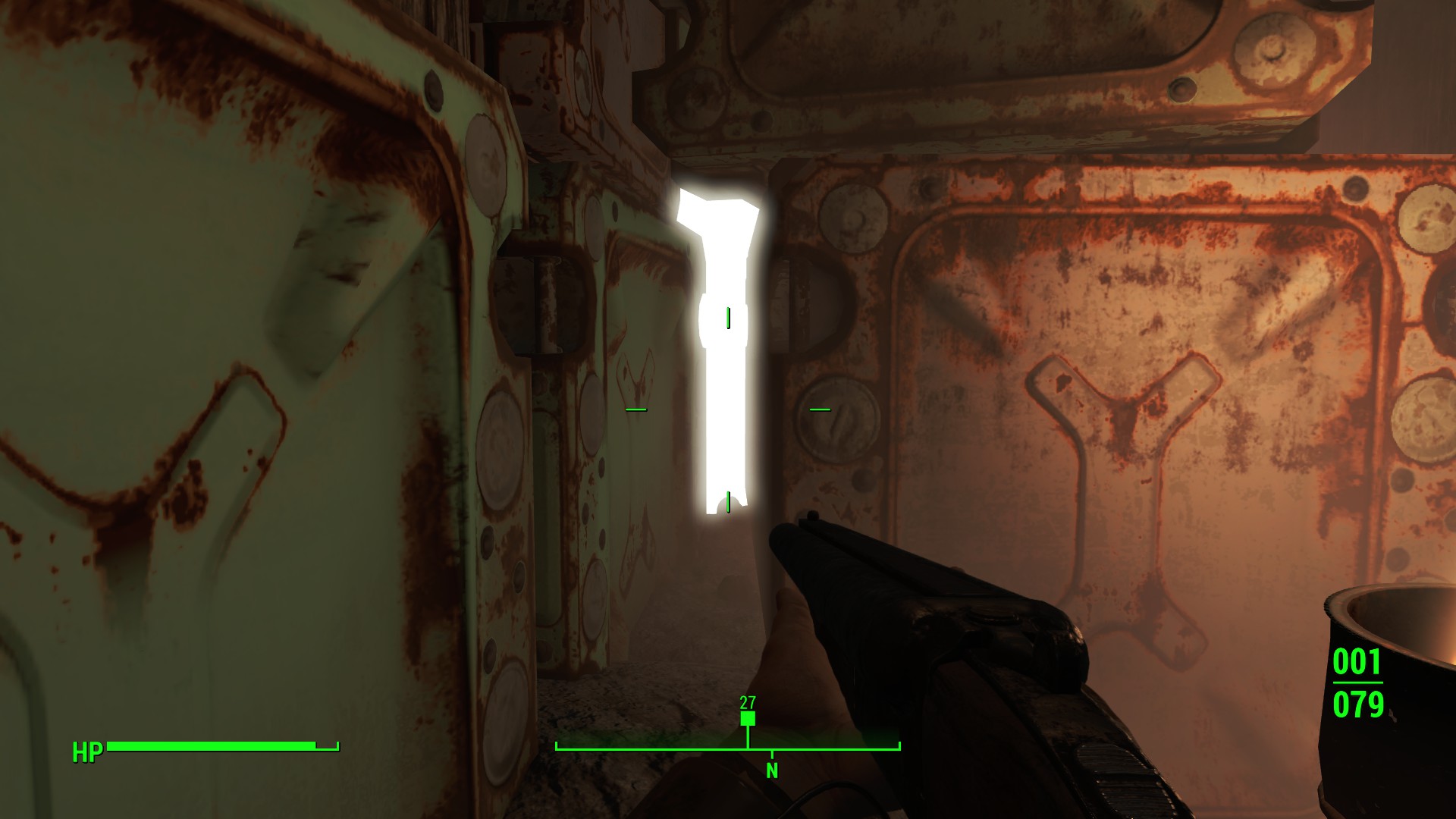
Graphics: It looks like Fallout 4. No new assets or resources yet. However, I did notice times where the buildings we were in weren’t...correct.

D11B322BBCC0E36C3358E337938FC78A8A3D91F4


6D3278EB256526E564AB167E9A435DE854F70E91


I like four walls on my buildings, but that’s just me.

Sound: Nothing new in terms of ambience. The dungeon-crawling tracks are the exact same as in base FO4 and that's all you'll hear for a while. However, when it comes to voice acting, I particularly enjoyed ADA’s. I don't know why, it just clicked. The rest of it is so-so. It's not terrible, but it's nothing to write home about.

Gameplay: Where do I even begin? I’ll probably start with the good part, which is the robot crafting. Bethesda took their new, excellent crafting system and applied it to custom-building robot companions. There are a lot of different combinations and, for those who like customisability or the prospect of making a settlement full of robots, it’s pretty sweet.

However, there’s a tradeoff. You don’t have every mod unlocked right away. I don’t mean just not having the right perks, you need at least INT 8 to get the perk to use every mod, but you need to find robot parts to unlock the mods. You do that by killing robots. Seems simple enough, but the DLC’s questline offers an alternative: Completing the three quests will unlock every mod. Seems easy, although...it isn’t.

My main problem with Fallout 3’s Mothership Zeta (which, believe me, I’ll get to later) is that it’s very linear. Fallout 3 is a linear game, but Zeta was even worse. If you didn’t have high points in energy weapons, you were so screwed. Yes, it wasn’t impossible, but it was a lot harder for you if you just used regular guns. Automatron is the exact same way and it’s infuriating. Stock up on fusion cells and energy weapons because otherwise, this DLC takes on a difficulty I can only describe as unfair. During 90% of the DLC, you will be wandering around through factories and other dungeons to kill robots and recover a Robobrain to break into the Mechanist’s lair. However, there’s a problem. Most -- not all, but most -- of the robots you kill explode upon dying. This wouldn’t be a problem if you didn’t spend most of your time in close quarters. I couldn’t count how many times I killed a robot and tried to quickly loot it for ammo only to have it explode in my face, making me reload my save. Other robots have attacks that temporarily blind you or disorient your character for around five seconds, making it impossible to aim or even run away in some cases.

The final showdown is the absolute worst. To me, it was Dark Souls levels of unfair. You fight through a massive factory to make it to the Mechanist, where he will throw everything he has at you. Every robot you fought will be there, along with eyebots that will continuously harass you and whittle your health down bit by bit. If you somehow survive long enough, the Mechanist will bring in a turret robot. Standing completely still at level 35 with moderate energy resistance only let me survive roughly twenty seconds of constant fire from the turret robot. It was to the point of where I had to use tgm (a console command, literally “Toggle God Mode”) to complete the DLC, then save and restart the game so I would get the achievements. And that was just the end. There is one other occasion in the middle of this DLC where you have to fight a massively overpowered robot for really no reason at all and then fight your way through an overpowered raider with power armor AND her pet robot.

To reiterate, making your own robot companion is great, but the difficulty is so harshly unbalanced in the AI’s favor that I honestly, wholeheartedly recommend cheating to complete the DLC.

Bottom Line: Crafting robots is nice, but the story is pointless, forgettable, and just too damn hard to even attempt. I eagerly await Far Harbor to do some justice in Fallout 4’s disappointing DLC offering thus far.
 
Last edited:
FO4_Add-On_Pack_FINAL_FARHARBOR_Agnostic_EN_1455633175.jpg

Fallout 4: Far Harbor
​

The first major expansion for Fallout 4. How does it stand out?

SPOILERS BEGIN

Story: Far Harbor presents itself as a case you receive at the Valentine Detective Agency. A couple has reported their daughter going missing and you can deduce she?s stolen a boat and sailed to Far Harbor, a small oceanside town off the coast of Maine. She?s gone there because she believes she?s a synth and has joined a refuge of people who?ve discovered they?re synths called Acadia. Upon arriving in Far Harbor, you?re immediately called to defend the town against invading creatures. Nearly every creature and hostile enemy you?ll face on The Island makes an appearance. The town is also being attacked by a mysterious force called The Fog, somewhat reminiscent of New Vegas? The Cloud, that spawns these hellish creatures and kills anyone who wanders too deep. Far Harbor defends itself using wind turbines that feed off the Fog and turn it into energy. You also learn that The Children of Atom has a presence on the island and basks in The Fog, wishing to let it spread, while Acadia and Far Harbor want to control it. An old man guides you through the fog to Acadia, where you find the missing girl, Kasumi, and the synth leader of Acadia, DiMA. This section of the DLC contains some of Bethesda?s better writing, since the game makes you decide whether Kasumi really is a synth and also questions you on whether you?re a synth. It?s entirely possible to remain apathetic to those questions, but answering them one way or the other can affect how characters feel towards you. DiMA also insists that Nick Valentine is his brother, whom he helped escape the Institute several years ago, which Nick denies. This is where the ?mystery? aspect of Far Harbor kicks off: Kasumi has learned that DiMA has some secret memories offloaded into a base controlled by the Children of Atom. Your task is to infiltrate the Children by completing an initiation ceremony (during which you?ll soak up a LOT of rads) and fight through DiMA?s defenses to the terminal where his memories lay. Automatron rears its ugly head here by forcing you to fight two Assaultron Dominators, one regular and one legendary, in order to finally make it to the memories.

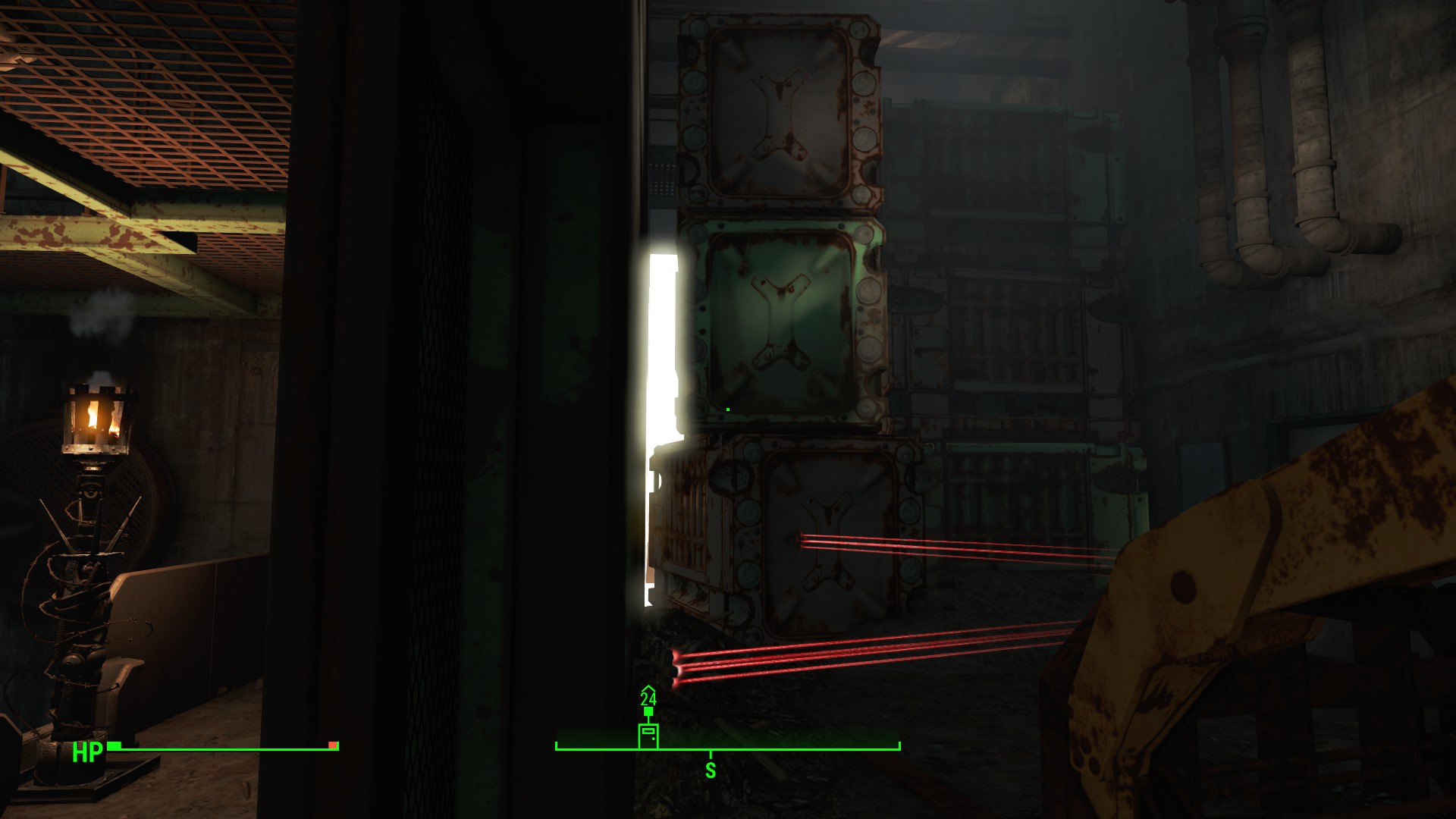
What happens next here is polarizing to me. It?s innovative and a neat use of the new building and settlement features, but at the same time, it didn?t feel like Fallout. The terminal you find is a VR simulator, where you?ll have to complete puzzles by building guiding laser beams and building pathways for indexers to uncover DiMA?s lost memories. The aesthetic and atmosphere here feels like a cross between Dystopia and TRON. Thankfully, you can leave the simulation at any time and your progress is saved, making sure you don?t have to repeat a puzzle or lose progress on a puzzle. Getting all the memories will give you your next quests: DiMA alludes to a synth infiltrator in Far Harbor, a Nuclear Launch Key, and a killswitch for Far Harbor?s defenses against the fog. You also learn that Nick is, in fact, DiMA?s brother, or rather, the only other surviving prototype synth. You are free to expose the killswitch and infiltrator to Far Harbor and give the nuclear code to the Children of Atom, or you can confront DiMA about all three.

This is where the story can diverge, and it is the second polarizing part of this DLC for me. I confronted DiMA about the synth replacement in Far Harbor and chose to go with him to the townspeople and have him stand trial. You have the option to defend him, and even if you do, Allen, a rather angry individual, tries to incite the town to attack Acadia en masse. At this point, you are presented with two different persuasion checks, one medium and one hard. I have enough Charisma to easily succeed in both, but to my shock, the townspeople attack Acadia anyway. This highlights one of my biggest problems with Fallout 4 and that is I can?t say no. From this point, your objective is to ?watch or participate in the attack on Acadia.? From what I can gather, there?s no difference, you pretty much have to participate because watching Bethesda?s AI fight itself is mind-numbing. Before the attack, though, you meet up with Allen and the townspeople before the attack and I picked the negative options wherever I could but you?re pretty much locked in. What infuriated me even more was that Nick Valentine, synth and my companion of choice during the DLC, had NOTHING to say on the attack on the synth refuge or the murder of his brother. I consulted some other people on what happened and what I learned was that, when you ?meet? the three factions of The Island, you?re given huge quests to help everyone. Depending on who you help and how many people you help, it can shift the ending I got. If I had done all of the side quests for Far Harbor, the citizens would?ve sided with me and Acadia would?ve been spared. I accept that it?s my fault for not doing those quests, but the game shouldn?t assume that I?d done at least one and present me with two different persuasion checks and then assume I hate Acadia by making me attack, despite me defending DiMA. I couldn?t help but think of the final confrontation with Legate Lanius in Fallout: New Vegas, where using Speech or Barter 100, you can talk down the most feared warrior in The Mojave and send him packing. I get Bethesda?s reasoning behind not helping the townspeople impacting who they stand with, but this is Fallout, putting enough time and points into a skill should effectively make me a god.

After the fact, Kasumi dies in the battle. Your final act in Far Harbor, if you got my ending, was to break the news to the family.

SPOILERS END

Any problem I had with the story could easily have been resolved if Bethesda had not removed skills and paid close attention to how Obsidian handled the use of extremely high skill checks to make people change their mind, but they wanted to do it their way. I?m glad they?ve admitted that the dialogue system didn?t work, but I wish Bethesda would?ve touched on the Perks system as well. I hope Fallout 5 returns to the old skill system.

Graphics: Far Harbor feels very different from base Fallout 4 in terms of location. Far Harbor has more water, more forest areas, and radstorms happen a lot more often. However, the atmosphere still feels like Fallout 4. I really don?t know what it is, but I didn?t feel like I was somewhere that different. Even Fallout 3?s DLC made you feel like you were somewhere completely different just from looking around, but so far, Fallout 4?s DLC doesn?t feel like I?m in a new location. It just feels like an extension of the Commonwealth.

Sound: I was a fan of DiMA?s voice acting, and I loved the backing track for the Children of Atom?s base, the Nucleus, but none of it felt too different. I think a lot of Fallout DLC, even New Vegas?, uses a lot of the stock music.

Gameplay: Aside from the new puzzle mechanic using the building system, it still plays like Fallout 4. Moving on...

Lasting Appeal: I feel like there?s a little more open-endedness to the story than Fallout 4?s base story, and you get a free perk depending on what ending you get, but other than that...meh. It definitely hasn?t stuck with me as much as other expansions I?ve played.

Bottom Line: While the writing manages to be surprisingly strong from Bethesda, and I'm sure if I had done the DLC differently I would be a little more satisfied with the ending, the experience I had reminds me of the gap left by skill points and Bethesda sometimes assuming you played the game a certain way. I hope that, if Fallout 5 rolls around, they put back the old system.

---

I bet you all thought I forgot about this thread. Got real busy with class and end of year projects. Nearing the end of New Vegas right now!
 

Latest posts

Back
Top