


- Joined
- Apr 23, 2008
- Messages
- 2,641
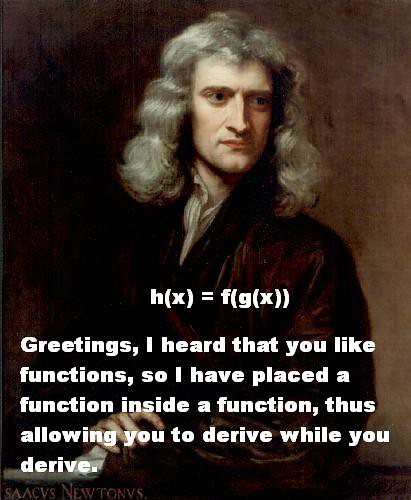
Dont get the joke, look below.


blahblahblah

Not as funny as Erdos's Ramsey group problem joke. And i don't think Newton was the guy to do composite functions first, actually functions were not defined until Dirichlet in the 18th century or so.
There is a branch in mathematics called Ramsey Theory. In Ramsey Theory there is a problem called the Group Problem. Basically, for the 3 group problem, it says how many people do you need in a group so that three people know each other mutually or three people are complete strangers? The answer is 6. The answer to the 4 group problem is 18. If an evil alien comes and asks you the 5 group problem and if you do not answer it correctly it will destroy the world you take all the mathematicians and computers in the world and put them on the 5 group problem. If he asks you the 6 group problem you attack it first before it attacks you.
The answer to the 5 group problem is between [43, 49], this is only integers. The answer to the 6 group problem is between [102, 165].
Note to self: Never actually invite a math major into my realm of humor...it will only bring pain and a slight feeling of inadequacy.
Not as funny as Erdos's Ramsey group problem joke. And i don't think Newton was the guy to do composite functions first, actually functions were not defined until Dirichlet in the 18th century or so.
There is a branch in mathematics called Ramsey Theory. In Ramsey Theory there is a problem called the Group Problem. Basically, for the 3 group problem, it says how many people do you need in a group so that three people know each other mutually or three people are complete strangers? The answer is 6. The answer to the 4 group problem is 18. If an evil alien comes and asks you the 5 group problem and if you do not answer it correctly it will destroy the world you take all the mathematicians and computers in the world and put them on the 5 group problem. If he asks you the 6 group problem you attack it first before it attacks you.
The answer to the 5 group problem is between [43, 49], this is only integers. The answer to the 6 group problem is between [102, 165].
You seriously knew all that off the top of your head?
It's possible, but that amount of info can only come from one source...wikipedia.
There was a seminar for advanced students in Z?rich that I was teaching and von Neumann was in the class. I came to a certain theorem, and I said it is not proved and it may be difficult. Von Neumann didn't say anything but after five minutes he raised his hand. When I called on him he went to the blackboard and proceeded to write down the proof. After that I was afraid of von Neumann.
* George P?lya, in How to Solve It (1957) 2nd ed.: p.xv.
Not as funny as Erdos's Ramsey group problem joke. And i don't think Newton was the guy to do composite functions first, actually functions were not defined until Dirichlet in the 18th century or so.
There is a branch in mathematics called Ramsey Theory. In Ramsey Theory there is a problem called the Group Problem. Basically, for the 3 group problem, it says how many people do you need in a group so that three people know each other mutually or three people are complete strangers? The answer is 6. The answer to the 4 group problem is 18. If an evil alien comes and asks you the 5 group problem and if you do not answer it correctly it will destroy the world you take all the mathematicians and computers in the world and put them on the 5 group problem. If he asks you the 6 group problem you attack it first before it attacks you.
The answer to the 5 group problem is between [43, 49], this is only integers. The answer to the 6 group problem is between [102, 165].

Sorry Frank, you lost me on the joke. Though the fact that my brain is still hung up on the definition what a group problem is. From the description it sounds vaguely like a stats problem, but that doesn't seem to be the case from looking at the answers. Got a link to a definition somewhere, because this is gonna bother me all day if I don't get it straight.
I think functions go back to at least 1700 or so with Liebniz, as a biproduct of hammering out the notation for abstract calculus.
Not sure if I'd really give Erdos billing as someone to thank for your computer though, he really doesn't figure that heavily into the history of Computer Science, he always seemed more a pure mathematician to me. I'd go more for folks like Turing, Church, Von Neumann, Dijkstra, etc.
Ok, I'll stop geeking out now.
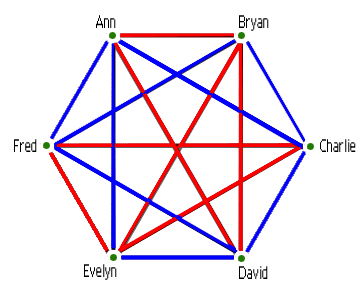

For 2 colours, Ramsey's theorem states that for any pair of positive integers (r,s), there exists a least positive integer R(r,s) such that for any complete graph on R(r,s) vertices, whose edges are coloured red or blue, there exists either a complete subgraph on r vertices which is entirely blue, or a complete subgraph on s vertices which is entirely red. Here R(r,s) signifies an integer that depends on both r and s. It is understood to represent the smallest integer for which the theorem holds.
I feel some what accomplish in knowing that I might have spawned the most intilectual discussion on this board.
If people do not believe that mathematics is simple, it is only because they do not realize how complicated life is.
~John Louis von Neumann
I could start an ethics topic that is simple but much more complex than this, yet retain all the sophistication and feeling. I have been wanting to do a post on viable games and balancing the teams.