


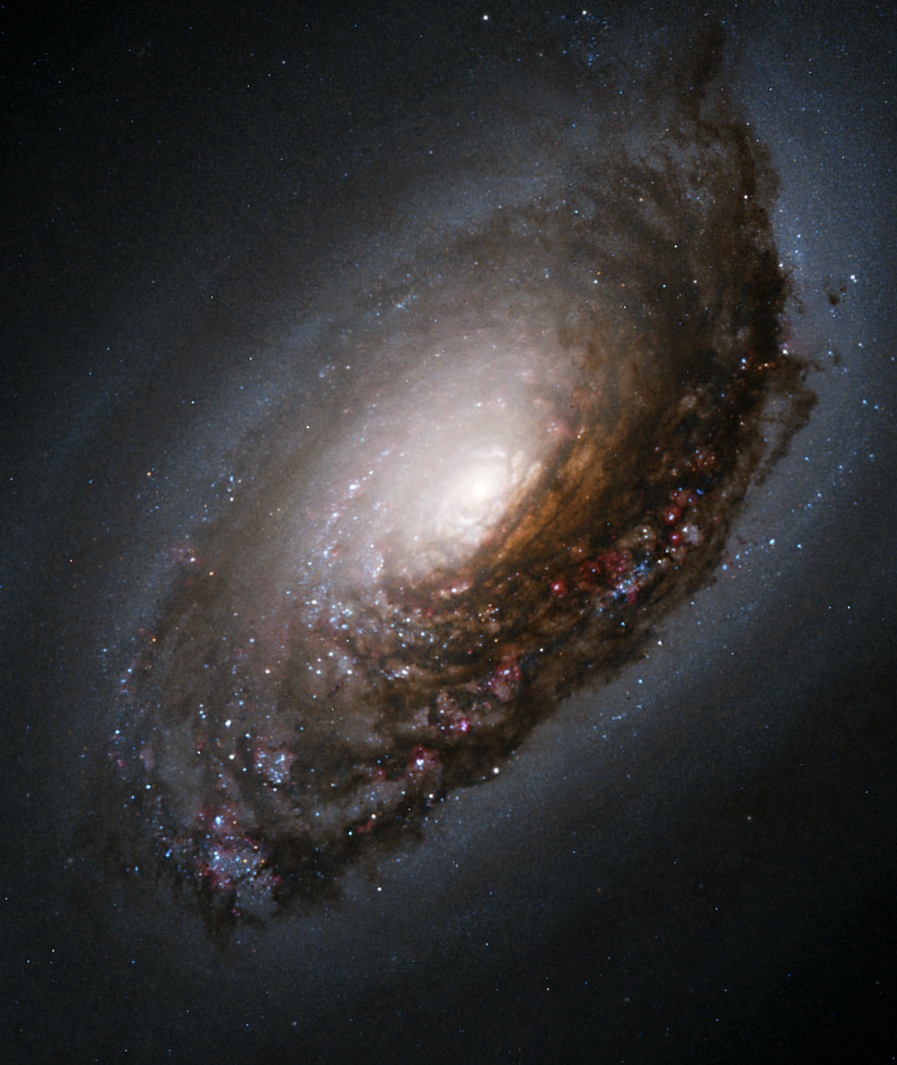
I thought I would share this with Galaxy enthusiasts. At first I thought it was just a Galaxy with a eerie looking cloud of gas, but when I researched it I found out there was a lot more to this Galaxy than I thought.
More info below
Info taken from Wiki
At first glance, M64 seems to be a fairly normal spiral galaxy. As in the majority of galaxies, all of the stars in M64 are orbiting in the same direction, clockwise as seen in the Hubble image.
However, recent detailed studies have led to the remarkable discovery that the interstellar gas in the outer regions of M64 rotates in the opposite direction from the gas and stars in the inner regions. The inner region has a radius of only approximately 3,000 light-years, while the outer section extends another 40,000 light-years. This pattern is believed to trigger the creation of many new stars around the boundary separating the two regions.
A collision of two galaxies has left a merged star system with an unusual appearance as well as bizarre internal motions. Astronomers believe that the oppositely rotating gas arose when M64 absorbed a satellite galaxy that collided with it, perhaps more than one billion years ago. Active formation of new stars is occurring in the shear region where the oppositely rotating gases collide, are compressed, and contract.
Particularly noticeable in the image are hot, blue young stars that have just formed, along with pink clouds of glowing hydrogen gas that fluoresce when exposed to ultraviolet light from newly formed stars. It is approximately 17 million light years from earth.
The small galaxy that impinged on its neighbour has now been almost completely destroyed, its stars either merged with the main galaxy or scattered into space, but signs of the collision persist in the backward motion of gas at the outer edge of M64.
More info below
Info taken from Wiki
At first glance, M64 seems to be a fairly normal spiral galaxy. As in the majority of galaxies, all of the stars in M64 are orbiting in the same direction, clockwise as seen in the Hubble image.
However, recent detailed studies have led to the remarkable discovery that the interstellar gas in the outer regions of M64 rotates in the opposite direction from the gas and stars in the inner regions. The inner region has a radius of only approximately 3,000 light-years, while the outer section extends another 40,000 light-years. This pattern is believed to trigger the creation of many new stars around the boundary separating the two regions.
A collision of two galaxies has left a merged star system with an unusual appearance as well as bizarre internal motions. Astronomers believe that the oppositely rotating gas arose when M64 absorbed a satellite galaxy that collided with it, perhaps more than one billion years ago. Active formation of new stars is occurring in the shear region where the oppositely rotating gases collide, are compressed, and contract.
Particularly noticeable in the image are hot, blue young stars that have just formed, along with pink clouds of glowing hydrogen gas that fluoresce when exposed to ultraviolet light from newly formed stars. It is approximately 17 million light years from earth.
The small galaxy that impinged on its neighbour has now been almost completely destroyed, its stars either merged with the main galaxy or scattered into space, but signs of the collision persist in the backward motion of gas at the outer edge of M64.
Last edited:





 .